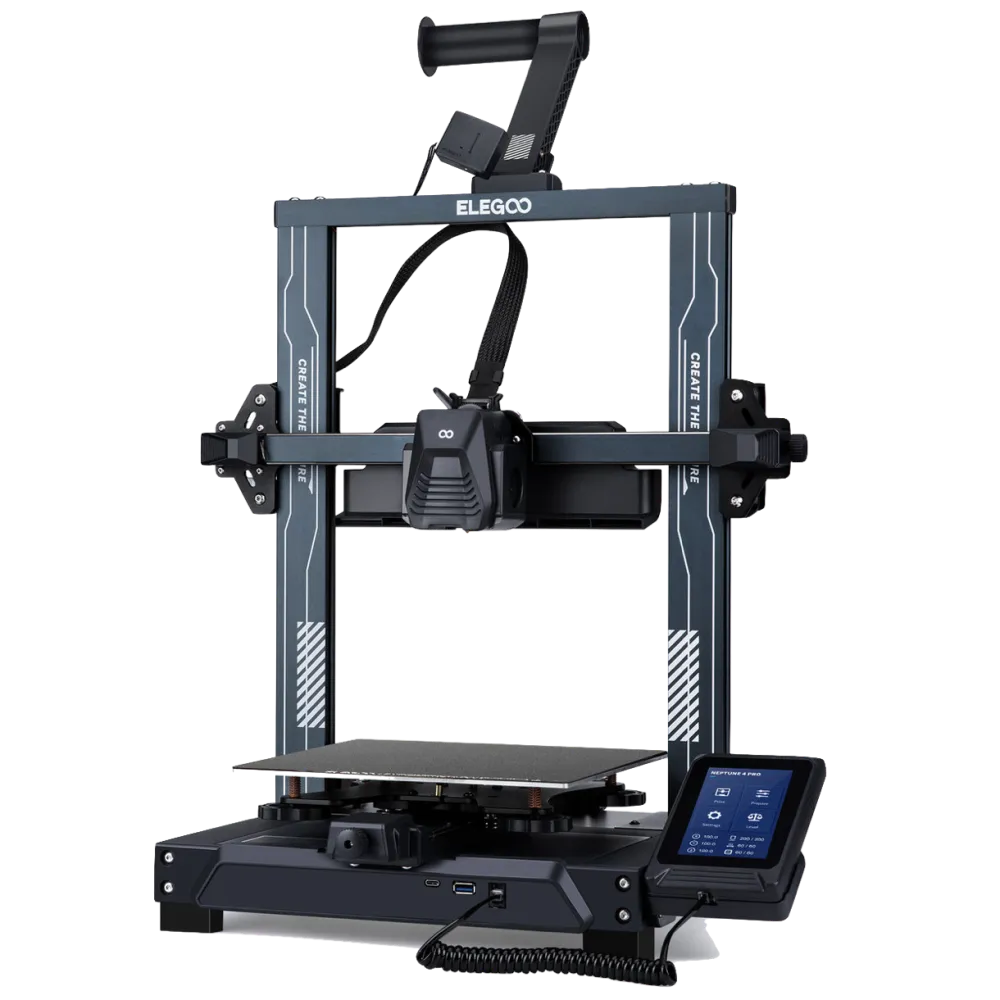
Elegoo Neptune 4 Pro
CAUTIONThis printer appears overdue for replacement, refresh, or discontinuation. If found at a strong discount and the printer still fits your needs, it may be worth comparing against newer alternatives. Support signals are limited across one or more tracked areas such as documentation, spare parts access, repair guidance, or support visibility.
Data refreshed: 16 May 2026
Where to buy
Specifications
- Build volume
- 225x225x265 mm
- Build size class
- Medium - Daypack / Backpack
- Price
- €209 (solo)
- Enclosure
- Open frame
- Chamber control
- None
- Materials
- PLA (all variants) · PETG · PHA · TPU · TPE
- Support materials
- —
- Bowden nozzle
- —
- Max hotend temp
- 300°C
- Max bed temp
- 110°C
- Max chamber temp
- —
- Nozzle material
- Brass
- Hardened nozzle
- —
- Nozzle count
- 1
- Max filament inputs
- 1
- True multi-material
- —
- Tool change
- Single Nozzle Pause Swap
Ownership
- Experience level
- Tinkerer
- Assembly
- Light Build
- Auto bed leveling
- Assisted
- Auto Z offset
- —
- Auto first layer
- —
- Runout sensor
- Yes
- Spaghetti detection
- —
- Error guidance
- Generic
- Warranty
- 3-6 months
- Spare parts
- Minimal
- Firmware version
- V1.3.1.4
Unlockable capabilities
- With hardened nozzle upgrade:
- Abrasive materials
Who this is for
For someone new to 3D printing: the tinkerer-level demands, raw error outputs, and limited official support create a steep and largely unguided learning curve that makes this printer a poor starting choice. For a home hobbyist: at €209 with a direct drive extruder, open ecosystem, and medium build volume, the Neptune 4 Pro offers meaningful capability at a low price, though its overdue lifecycle position means the window for full software and parts support is likely narrowing. For someone upgrading from an existing printer: the open Klipper ecosystem and direct drive extruder add configuration flexibility over locked-down entry machines, though the open frame keeps the material range conservative and the overdue lifecycle position makes a newer alternative worth considering alongside it.
PrintSignals Review
Elegoo Neptune 4 Pro Review
Assessment
Recent firmware activity and a brand pattern of continued support for replaced models both suggest the Neptune 4 Pro is not yet abandoned. The printer is, however, well past the typical replacement window for this brand's lineup, which averages around 1.2 years. That positioning is pattern-based, with no official discontinuation announced, but it signals that future software investment is likely to diminish as support attention shifts toward newer models. Buyers should treat current firmware activity as encouraging context, not a guarantee of long-term continuity.
Build and print volume
The Neptune 4 Pro's build area measures 225x225x265mm, placing it in the daypack-to-backpack size range. That footprint is practical for most hobby parts and medium-size PLA or PETG prints. The printer runs open frame, with no enclosure to retain ambient heat around the print area. Although the hotend reaches 300°C and the bed reaches 110°C, the open design limits reliable material capability far more than those temperature ceilings suggest.
Material capability
The Neptune 4 Pro's reliable material range covers PLA in all variants, PETG, and PHA, which are capable and widely-used materials suited to most hobby and practical projects. The open frame limits the reliable range to these warp-stable filaments, as materials requiring a thermally stable environment are not achievable without enclosure. The direct drive extruder puts flexible filaments like TPU and TPE within hardware reach, though results depend heavily on tuning; abrasive materials require a separately purchased hardened nozzle upgrade. Multi-color printing uses a manual pause-and-swap method, where each color change requires unloading and reloading filament by hand, carrying cross-contamination risk between materials rather than supporting true multi-material capability.
Setup and ownership
Minor mechanical setup puts the Neptune 4 Pro print-ready within 15 to 45 minutes of unboxing. Assisted bed leveling and filament runout detection reduce two common sources of manual intervention from routine use. Beyond those assists, this is a Klipper-based printer that expects a tinkerer mindset: tuning, calibration, and troubleshooting are ongoing, and error messages are generic text or raw firmware output rather than structured guidance, leaving diagnosis to the owner. At €209 in the budget tier, the open ecosystem means any slicer is compatible and filament sourcing carries no brand restrictions; a hardened nozzle is a separately purchased upgrade for abrasive materials.
Support and longevity
The Neptune 4 Pro carries a 3 to 6 month warranty depending on the component, leaving buyers largely self-reliant on support well within a typical ownership window. Official spare parts availability is minimal, with very few items in the official store, and parts not listed there may be obtainable by contacting manufacturer support directly. When hardware problems arise, this manufacturer has shown limited official transparency, with community-sourced fixes typically filling the gap rather than direct manufacturer responses. The open ecosystem adds reach beyond the manufacturer: open-source Klipper firmware and standard G-code mean community resources, modifications, and third-party support are broadly accessible.