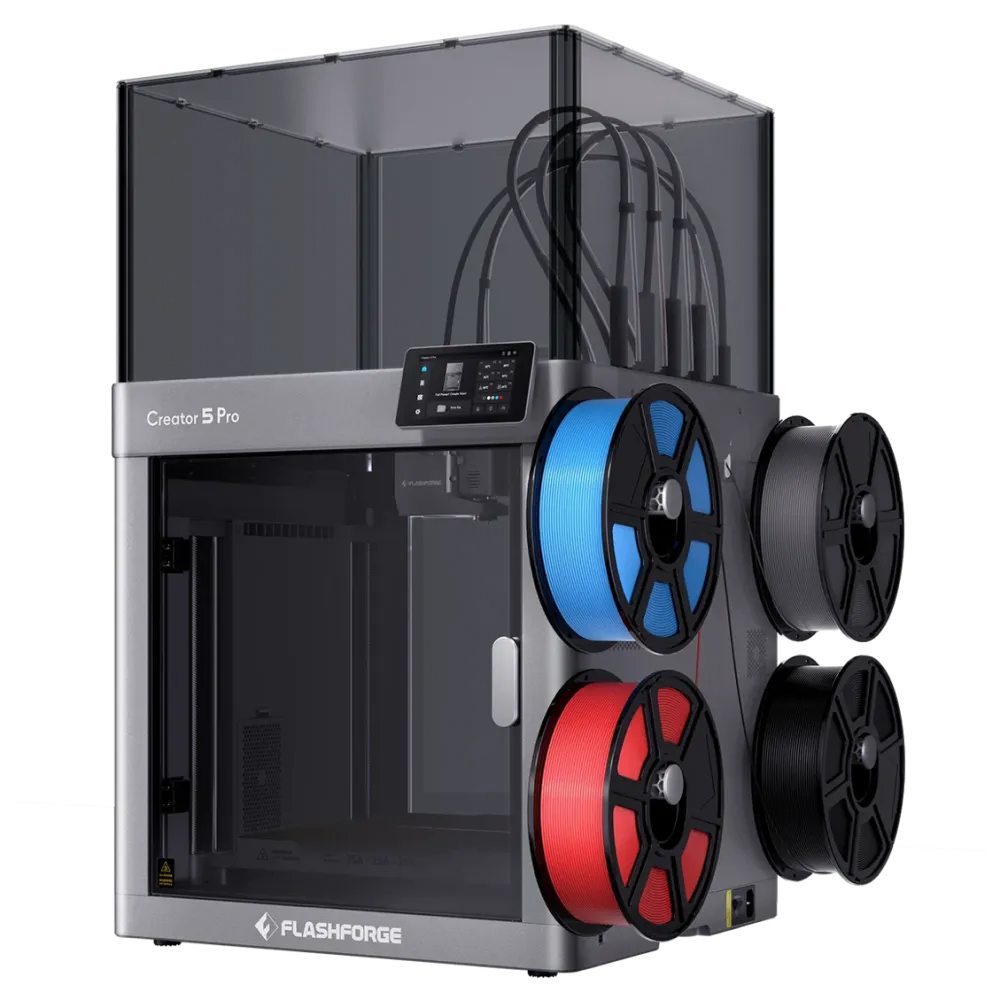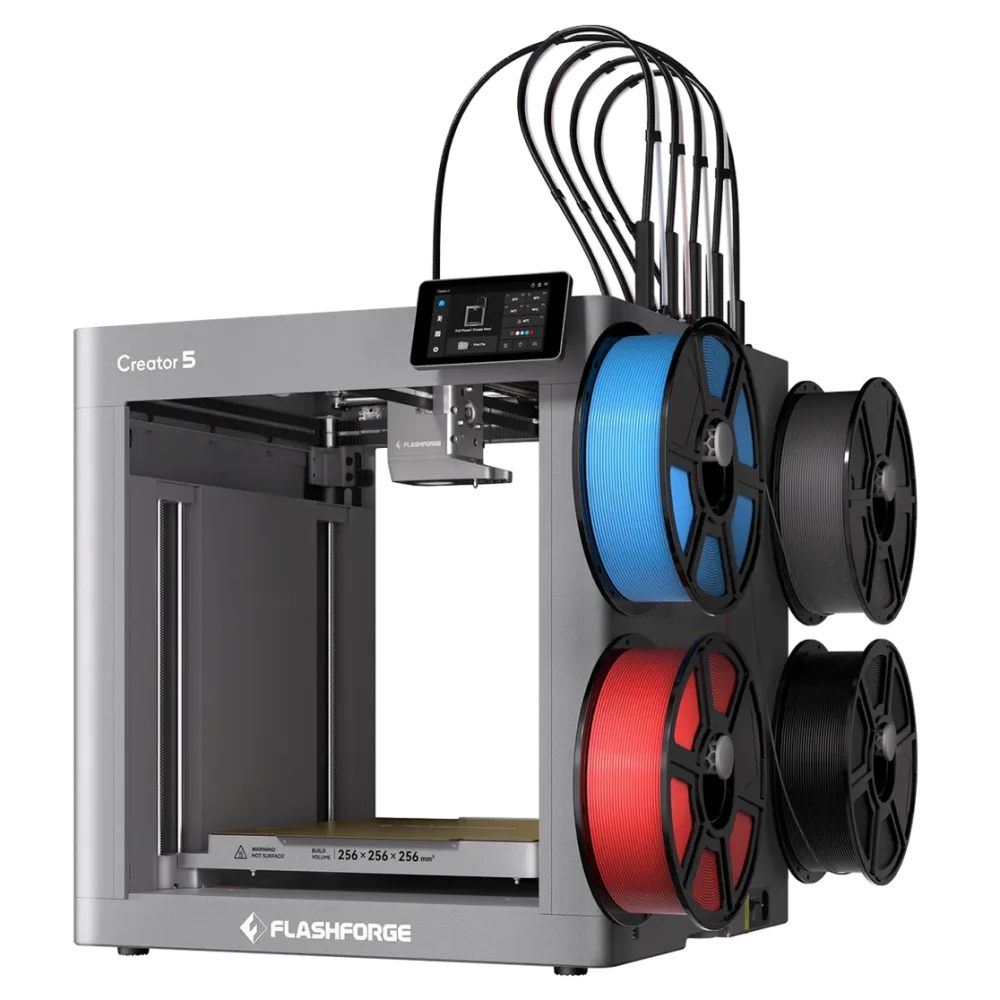
Flashforge Creator 5
WAITThis printer is relatively new. Firmware cadence and support signals are still building and may not yet reflect its long-term trajectory.
Data refreshed: 16 May 2026
Where to buy
Specifications
- Build volume
- 256x256x256 mm
- Build size class
- Medium - Daypack / Backpack
- Price
- €799 (combo)
- Enclosure
- Open frame
- Chamber control
- None
- Materials
- PLA (all variants) · PETG · PHA · TPU · TPE
- Support materials
- PVA · PVOH · BVOH as simultaneous support material
- Bowden nozzle
- —
- Max hotend temp
- 350°C
- Max bed temp
- 120°C
- Max chamber temp
- —
- Nozzle material
- Brass
- Hardened nozzle
- —
- Nozzle count
- 4
- Max filament inputs
- 4
- True multi-material
- Yes
- Tool change
- Tool Changer Pause Swap
Ownership
- Experience level
- Intermediate
- Assembly
- Light Build
- Auto bed leveling
- Automatic
- Auto Z offset
- Yes
- Auto first layer
- Yes
- Runout sensor
- Yes
- Spaghetti detection
- Yes
- Error guidance
- Error Coded
- Warranty
- 3-12 months
- Spare parts
- Minimal
- Firmware version
- —
Unlockable capabilities
- With hardened nozzle upgrade:
- Abrasive materials
Who this is for
The announced configuration points toward intermediate users who want multi-material toolhead printing within PLA, PETG, and PHA, with soluble support capability included in the base configuration. Users who need engineering materials will find the open-frame design a hard constraint regardless of the temperature ceiling. This is a pre-launch assessment only, and buyers should revisit once post-launch reviews can verify what the announced specifications deliver.
PrintSignals Review
Flashforge Creator 5 Review
Assessment
This review is based on announced specifications only. The Flashforge Creator 5 has not yet launched, and real-world performance, firmware behavior, and support quality cannot be assessed at this stage. What is announced points toward a mid-range, open-frame toolchanger for multi-material printing with PLA, PETG, and related filaments, with the four-toolhead multi-spool system included in the bundled configuration. Specifications may still change before launch, and buyers should treat this as a directional read rather than a purchase recommendation.
Build and print volume
The Creator 5 is announced with a 256x256x256 mm medium build volume, sufficient for most everyday parts. The design is open frame, providing no thermal containment. The 350°C hotend and 120°C bed ceilings reflect hardware headroom. For a printer without an enclosure, ambient conditions shape the practical material range more than temperature specs do.
Material capability
The reliable print range covers PLA in all variants, PETG, and PHA — the warp-stable filaments suited to open-frame printing. The direct drive extruder extends hardware capability to TPU and TPE, though those materials require careful tuning. Abrasive-capable printing requires a separately purchased hardened nozzle, as the stock brass nozzle is not rated for abrasives. The four dedicated toolheads enable simultaneous multi-material printing without cross-contamination or purging waste, unlocking PVA, PVOH, and BVOH as soluble support options. Color changes pause the print for a swap, announced as fast, and the included multi-spool system handles automatic filament handoff when a spool runs out.
Setup and ownership
The Creator 5 targets users with some prior 3D printing experience. The multi-toolhead workflow and occasional manual firmware steps add complexity, though guidance is announced as available for most situations. Assembly is minor at 15 to 45 minutes, and the automation suite covers bed leveling, Z-offset, first-layer calibration, runout detection, and failure detection. Error codes display on screen and are searchable on the brand wiki, though troubleshooting requires a manual lookup rather than a QR scan.
Support and longevity
Support quality, spare parts access, and warranty coverage cannot be assessed before the printer launches. These dimensions will require real-world evaluation once the Creator 5 is available. What is announced describes a semi-open ecosystem: open slicers and third-party filament are noted as compatible, and community modifications are available. Some smart features or integrations may require Flashforge's own software, which limits the degree of ecosystem independence.