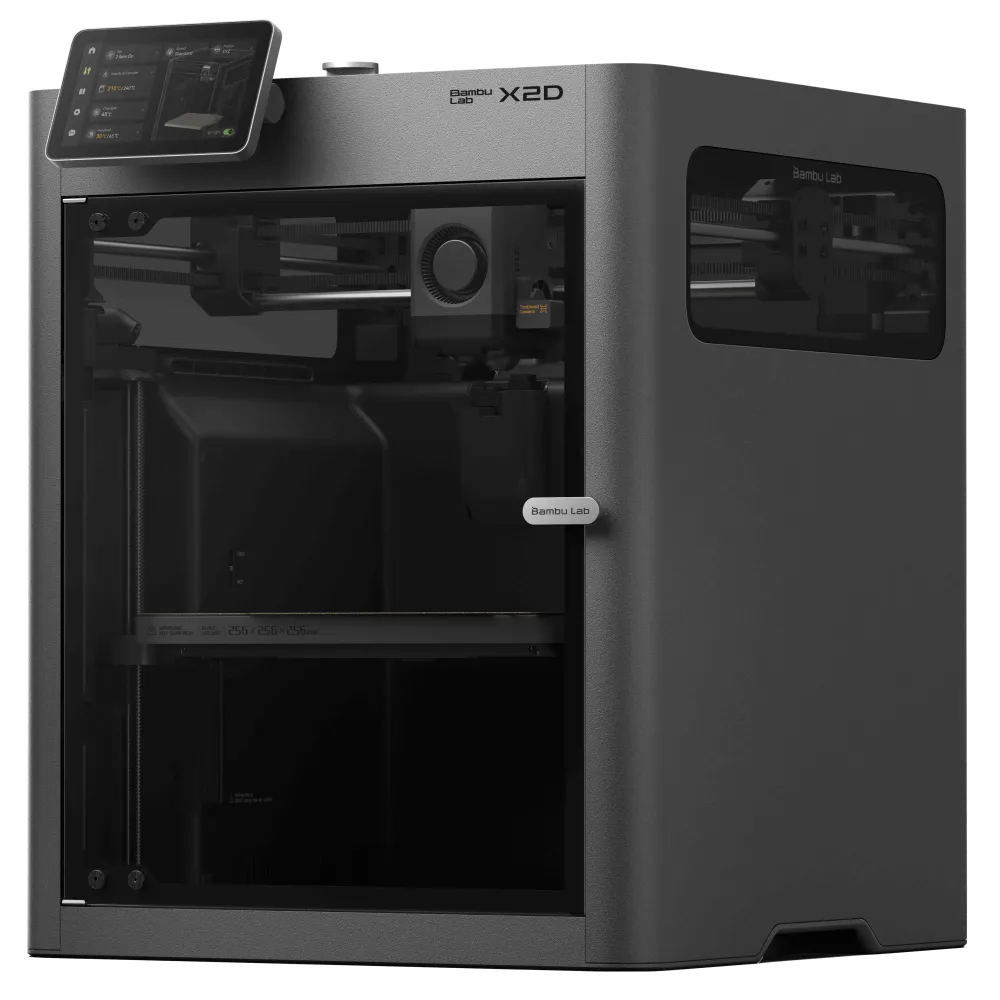
Bambu Lab X2D
BUYThis printer is relatively new. Firmware cadence and support signals are still building and may not yet reflect its long-term trajectory.
Data refreshed: 16 May 2026
Where to buy
Specifications
- Build volume
- 256x256x260 mm
- Build size class
- Medium - Daypack / Backpack
- Price
- €629 (solo)
- Enclosure
- Full enclosure
- Chamber control
- Active Controlled
- Materials
- ABS · ASA · HIPS · Nylon (PA6/PA12) · PETG · PHA · PLA (all variants) · PVB · TPU · TPC · TPE
- Support materials
- PVA · PVOH · BVOH as simultaneous support material
- Bowden nozzle
- PLA (all variants) · PETG · PHA
- Max hotend temp
- 300°C
- Max bed temp
- 120°C
- Max chamber temp
- 65°C
- Nozzle material
- Hardened Steel
- Hardened nozzle
- Included — CF/GF abrasive variants. While Nylon-CF not possible at this tier.
- Nozzle count
- 2
- Max filament inputs
- 16
- True multi-material
- Yes
- Tool change
- Dual Nozzle Purge Based
Ownership
- Experience level
- Beginner-friendly
- Assembly
- Light Build
- Auto bed leveling
- Automatic
- Auto Z offset
- Yes
- Auto first layer
- Yes
- Runout sensor
- Yes
- Spaghetti detection
- Yes
- Error guidance
- QR Direct
- Warranty
- 3-12 months
- Spare parts
- Comprehensive
- Firmware version
- 01.01.00.00
Who this is for
The X2D is well matched to first-time buyers who want engineering material capability with minimal setup friction and a managed, integrated experience. The closed ecosystem is the primary limitation for buyers who prefer third-party slicer workflows or open integration with external tools. Those planning frequent multi-color prints should note that transitions are purge-based at medium efficiency, a factor in filament consumption per job.
PrintSignals Review
Bambu Lab X2D Review
Assessment
The X2D launched recently with no successor products detected, placing it at the most favorable lifecycle point for a new purchase. Active firmware development confirms continued manufacturer investment. Bambu Lab carries the strongest support responsiveness pattern observed across tracked brands: when hardware problems arise, the company takes public ownership and follows through with official fixes. The closed ecosystem is the primary consideration a buyer should weigh before committing.
Build and print volume
The X2D offers a medium-size build volume of 256 × 256 × 260 mm. Full enclosure provides thermal containment, which limits warping risk and extends the reliable material range compared to open-frame designs. The actively controlled chamber reaches 65°C, which is what engineering materials such as ABS, ASA, and Nylon require to print reliably. A 300°C hotend and 120°C bed back that capability.
Material capability
Multi-color printing requires the multi-spool add-on, sold separately, which expands to five filament inputs, upgradeable to sixteen, with automatic spool handoff for longer prints. The primary direct drive nozzle with hardened steel covers ABS, ASA, HIPS, Nylon (PA6 and PA12), PETG, PHA, PLA in all variants, PVB, and flexible materials including TPU, TPC, and TPE. CF and GF abrasive variants are achievable at stock configuration, though Nylon-CF is not reliably printable at this temperature tier. Running both nozzles simultaneously unlocks PVA, PVOH, and BVOH as dedicated soluble support materials, though the secondary Bowden nozzle limits its own reliable range to PLA, PETG, and PHA.
Setup and ownership
The X2D is designed for first-time 3D printer owners, with fully integrated hardware, software, and slicer delivering a consistent first-print experience with minimal manual configuration. Assembly involves minor mechanical setup, typically completed in 15 to 45 minutes. Automation covers bed leveling, Z-offset calibration, first-layer calibration, filament runout detection, and print failure detection, handling most of what typically trips up new users. When errors occur, on-screen QR codes link directly to the specific fix for each error type.
Support and longevity
Spare parts availability is comprehensive through official channels, and warranty coverage runs from 3 to 12 months depending on the component. Software support is covered by a manufacturer-published commitment through 14 April 2031, providing buyers with a clear update horizon. The firmware is proprietary and the ecosystem is closed, with third-party integrations requiring manufacturer authorization. The slicer and consumables are built around Bambu Lab's own products rather than open, multi-brand compatibility.