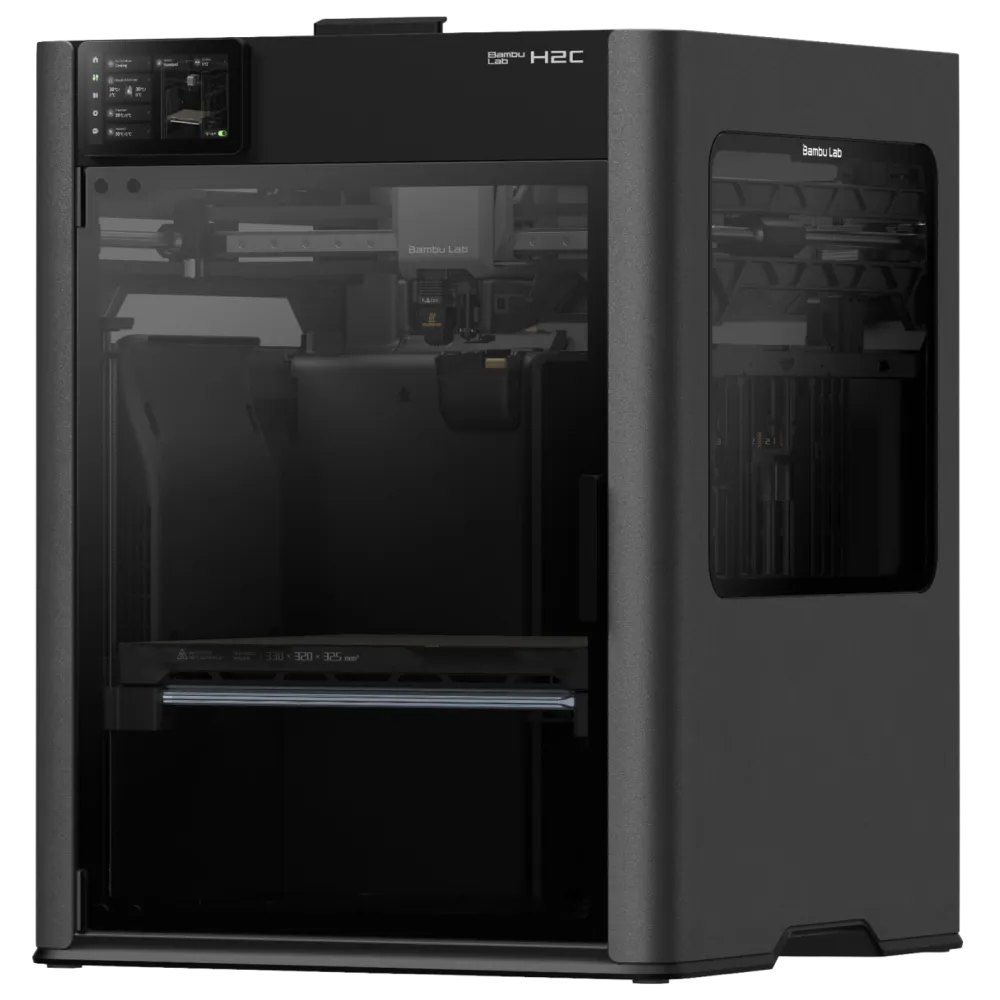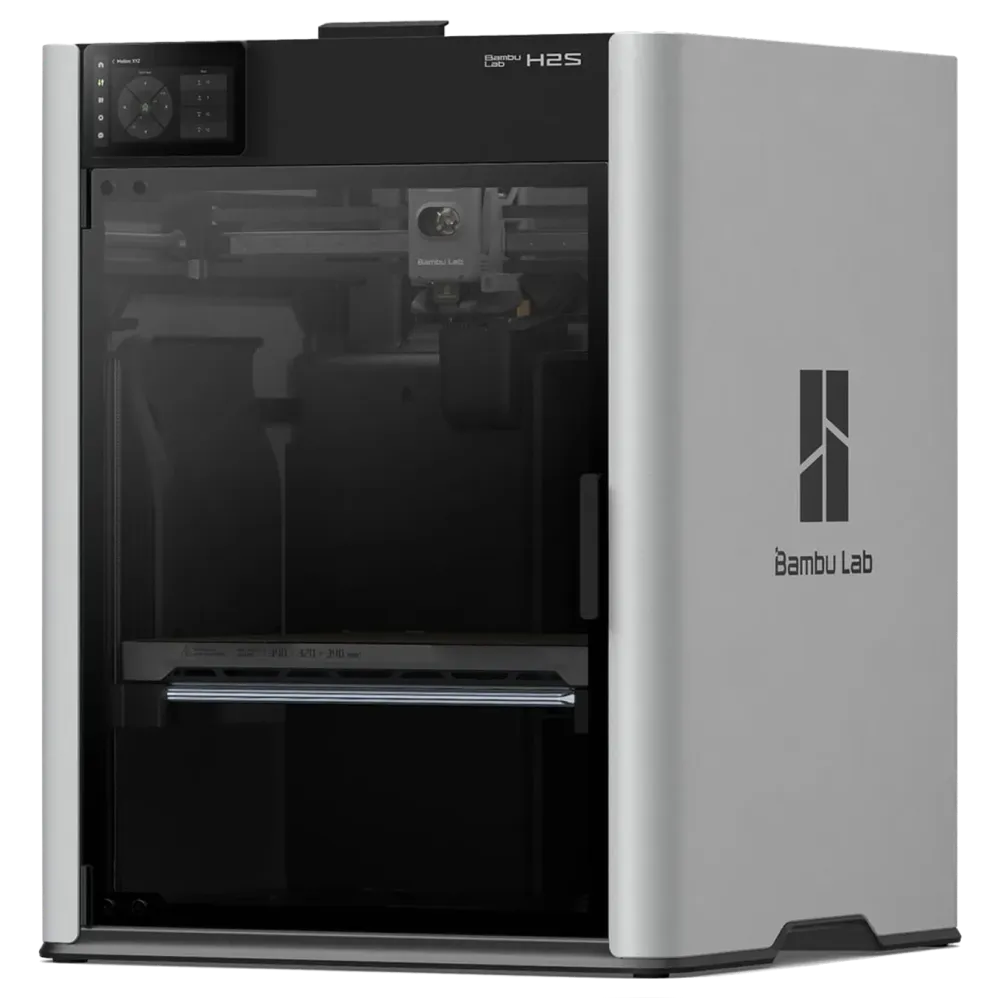
Bambu Lab H2S
BUYThis printer is relatively new. Firmware cadence and support signals are still building and may not yet reflect its long-term trajectory.
Data refreshed: 16 May 2026
Where to buy
Specifications
- Build volume
- 340x320x340 mm
- Build size class
- Large - Carry-on Suitcase
- Price
- €1,149 (solo)
- Enclosure
- Full enclosure
- Chamber control
- Active Controlled
- Materials
- ABS · ASA · HIPS · Nylon (PA6/PA12) · PC · PC-ABS · PETG · PHA · PLA · PPS · PVB · TPU · TPC · TPE
- Support materials
- —
- Bowden nozzle
- —
- Max hotend temp
- 350°C
- Max bed temp
- 120°C
- Max chamber temp
- 65°C
- Nozzle material
- Hardened Steel
- Hardened nozzle
- Included — CF/GF abrasive variants · Nylon-CF · PAHT-CF · PC-CF
- Nozzle count
- 1
- Max filament inputs
- 24
- True multi-material
- —
- Tool change
- Single Nozzle Purge Based
Ownership
- Experience level
- Intermediate
- Assembly
- Minimal
- Auto bed leveling
- Automatic
- Auto Z offset
- Yes
- Auto first layer
- Yes
- Runout sensor
- Yes
- Spaghetti detection
- Yes
- Error guidance
- QR Direct
- Warranty
- 3-12 months
- Spare parts
- Comprehensive
- Firmware version
- 01.02.00.00
Who this is for
The H2S suits buyers who need a large build area with engineering-material capability and want the backing of a manufacturer with an established record of support follow-through and a defined software longevity commitment. The closed ecosystem limits flexibility for buyers who rely on third-party slicer integrations, and the single-nozzle purge method is not suited to workflows requiring true multi-material output without cross-contamination risk. Buyers printing primarily in PLA or PETG at smaller scales will find more capability here than their workflow requires.
PrintSignals Review
Bambu Lab H2S Review
Assessment
The H2S is at an early point in its lifecycle, recently launched with no successor in sight. Active firmware development and a published software support commitment through August 2030 confirm the manufacturer is investing in this model's longevity. Bambu Lab has the strongest support responsiveness among manufacturers covered here — public acknowledgment of hardware issues and official follow-through are the consistent outcome. The primary consideration before buying is not timing risk, but whether this printer's capability envelope and closed-ecosystem constraints match the buyer's actual workflow.
Build and print volume
The build area spans 340x320x340mm — roughly the volume of a carry-on suitcase — giving genuine room for large PLA, PETG, and engineering-material parts within a single print. Full enclosure provides thermal containment that open-frame designs cannot. This expands the reliable material range to include ABS, ASA, Nylon, and PC — materials that require a controlled thermal environment to print reliably. The actively controlled chamber reaches 65°C, and the 350°C hotend and 120°C bed leave ample thermal headroom across the full supported material range.
Material capability
Multi-color printing requires the separately purchased multi-spool add-on, which expands from one input to four — up to twenty-four — and adds automatic spool handoff for unattended long prints. The reliable material range covers PLA, PETG, ABS, ASA, HIPS, Nylon, PC, PC-ABS, PPS, PVB, and PHA, with the stock hardened steel nozzle extending this to abrasive composites including Nylon-CF and PC-CF. Direct drive hardware adds reach for flexible filaments such as TPU, though flexible printing remains technically demanding and tuning-dependent. Color swaps flush filament on each change, generating waste and longer print times as color count rises; cross-contamination limits reliable material mixing.
Setup and ownership
The printer arrives near-fully assembled, with integrated hardware, software, and slicer, and typically reaches first print in under 15 minutes. The intermediate ownership rating reflects the breadth of capability — advanced materials, large builds, extended workflows — not the difficulty of daily operation. Routine use is heavily automated: bed leveling, Z-offset, first-layer calibration, runout detection, and print failure monitoring all run without manual input. When errors occur, on-screen QR codes link directly to the specific fix.
Support and longevity
Official support channels, spare parts, and documentation are all broadly available — warranty coverage runs from 3 to 12 months depending on the component. When hardware problems arise, this manufacturer publicly takes ownership and follows through with official fixes — the strongest support responsiveness among manufacturers covered here. The ecosystem is closed, built around the manufacturer's own slicer and consumables. Proprietary firmware restricts third-party tool access, and authorization is required for integrations outside the manufacturer's stack.