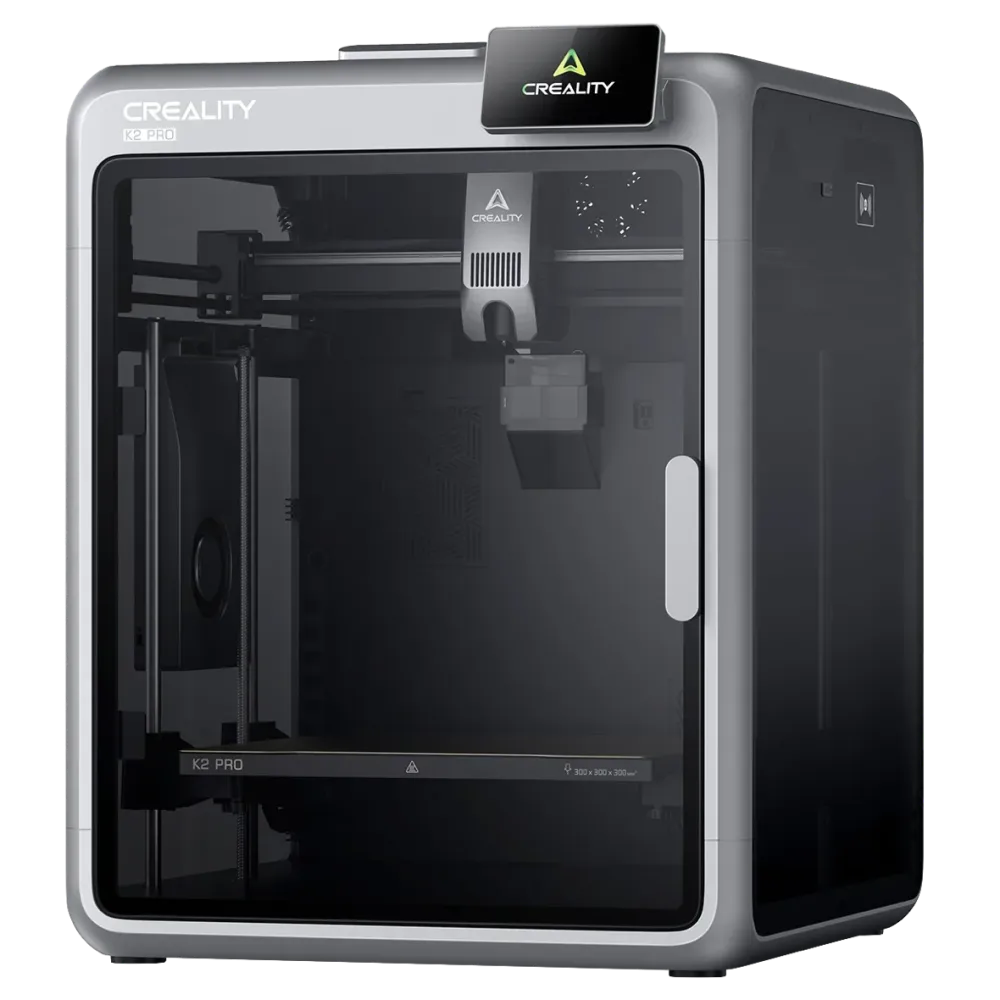
Creality K2 Pro
BUYThis printer is relatively new. Firmware cadence and support signals are still building and may not yet reflect its long-term trajectory.
Data refreshed: 16 May 2026
Where to buy
Specifications
- Build volume
- 300x300x300 mm
- Build size class
- Medium - Daypack / Backpack
- Price
- €699 (solo)
- Enclosure
- Full enclosure
- Chamber control
- Passive Controlled
- Materials
- ABS · ASA · HIPS · Nylon (PA6/PA12) · PETG · PHA · PLA (all variants) · PVB · TPU · TPC · TPE
- Support materials
- —
- Bowden nozzle
- —
- Max hotend temp
- 300°C
- Max bed temp
- 110°C
- Max chamber temp
- 60°C
- Nozzle material
- Hardened Steel
- Hardened nozzle
- Included — CF/GF abrasive variants. While Nylon-CF not possible at this tier.
- Nozzle count
- 1
- Max filament inputs
- 16
- True multi-material
- —
- Tool change
- Single Nozzle Purge Based
Ownership
- Experience level
- Beginner-friendly
- Assembly
- Minimal
- Auto bed leveling
- Automatic
- Auto Z offset
- Yes
- Auto first layer
- Yes
- Runout sensor
- Yes
- Spaghetti detection
- Yes
- Error guidance
- Error Coded
- Warranty
- 3-12 months
- Spare parts
- Partial
- Firmware version
- 1.1.5.5
Who this is for
The K2 Pro suits first-time buyers wanting access to enclosed materials — ABS, ASA, Nylon, and more — without a steep learning curve. Multi-color is available with the add-on, but this is a purge-based single-nozzle system — color swaps only, not true multi-material capability. Buyers who rely on direct manufacturer transparency for hardware problems, or who need true multi-material printing, will find meaningful limitations here.
PrintSignals Review
Creality K2 Pro Review
Assessment
The K2 Pro launched recently with no successor in sight, making the timing favorable for buyers entering now. Firmware has been updated within the last 90 days, confirming the manufacturer is actively maintaining this model. Support is generally reliable across most dimensions, but when hardware problems arise, official transparency is limited — community-sourced fixes tend to resolve what official channels do not. Buyers who lean heavily on direct manufacturer support for hardware issues should factor that pattern into their decision.
Build and print volume
The 300x300x300mm build area is mid-size — practical for most household prints and PLA/PETG functional parts, with room for batch work. Full enclosure provides thermal containment, reducing warping risk and enabling materials that require stable thermal conditions. The chamber reaches up to 60°C passively, through retained heat from the bed and motors — no dedicated heater means actual conditions vary with ambient temperature and print timing. A 110°C bed and 300°C hotend give the system thermal headroom for the engineering materials the enclosure makes practical.
Material capability
The multi-spool system is sold separately — it supports 4 filament inputs (expandable to 16), enables multi-color printing, and provides automatic filament handoff when a spool runs out. The enclosed design makes a wide material range practical: ABS, ASA, HIPS, Nylon (PA6/PA12), PETG, PHA, PLA, and PVB; the hardened steel nozzle adds CF and GF abrasive capability, though Nylon-CF is not supported at this tier. Color swaps are purge-based through a single nozzle — waste accumulates with each change, efficiency is low, and cross-contamination limits reliable mixed-material use. Direct drive hardware supports flexible materials — TPU, TPC, TPE — though results depend on tuning.
Setup and ownership
The K2 Pro is designed for first-time owners — setup is near-fully assembled and typically takes under 15 minutes to a first print. Automatic bed leveling, Z-offset calibration, first-layer calibration, filament runout detection, and print failure detection handle most of the routine friction. Error codes display on-screen and are searchable via the brand wiki. There is no QR code, meaning each lookup requires a manual search.
Support and longevity
Spare parts availability is partial — some common wear items can be sourced directly from the manufacturer. Warranty coverage runs from 3 to 12 months depending on the component, which means critical parts may be covered for less time than the printer itself remains useful. The ecosystem is semi-open: standard slicers and third-party filament work without restriction, and community modifications are available. Some of the manufacturer's smart features or integrations may require their own software.