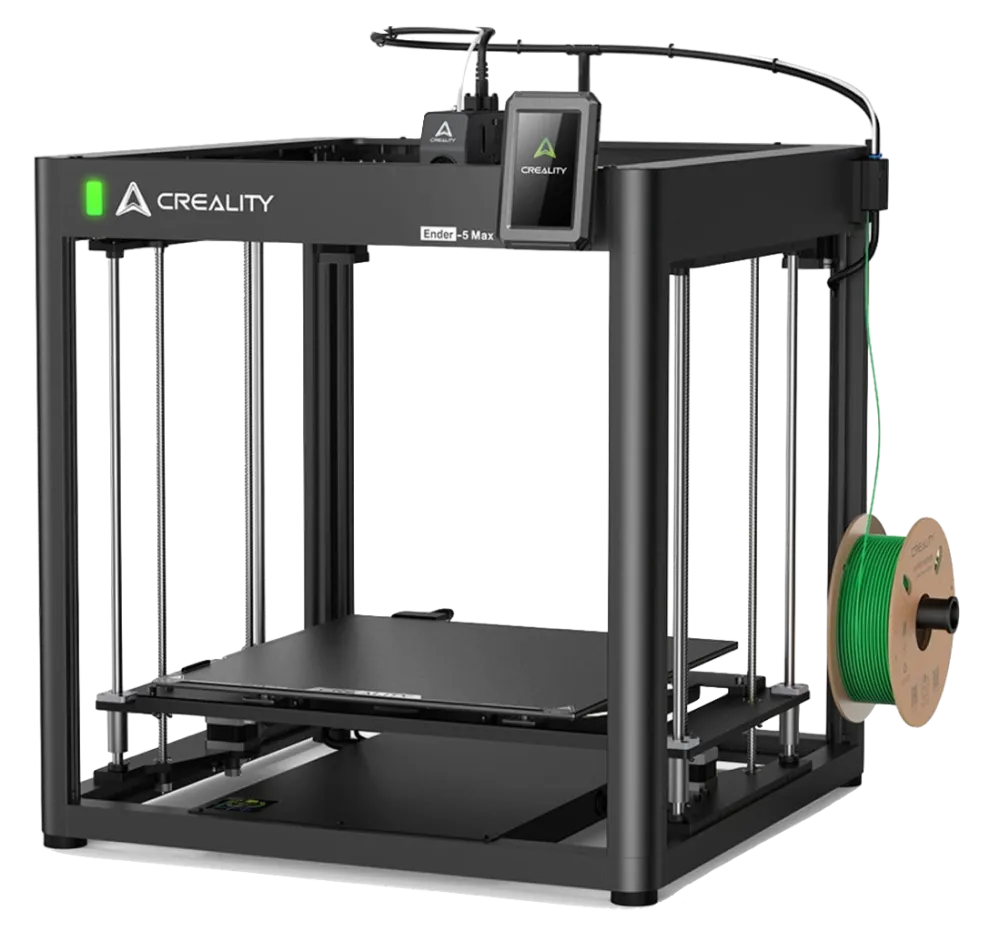
Creality Ender-5 Max
CAUTIONFirmware updates appear to be slowing down, with no recent update signal in over 6 months.
Data refreshed: 16 May 2026
Where to buy
Specifications
- Build volume
- 400x400x400 mm
- Build size class
- Large - Carry-on Suitcase
- Price
- €599 (solo)
- Enclosure
- Open frame
- Chamber control
- None
- Materials
- PLA (all variants) · PETG · PHA · TPU · TPE
- Support materials
- —
- Bowden nozzle
- —
- Max hotend temp
- 300°C
- Max bed temp
- 100°C
- Max chamber temp
- —
- Nozzle material
- Brass
- Hardened nozzle
- —
- Nozzle count
- 1
- Max filament inputs
- 1
- True multi-material
- —
- Tool change
- Single Nozzle Pause Swap
Ownership
- Experience level
- Intermediate
- Assembly
- Extended Build
- Auto bed leveling
- Automatic
- Auto Z offset
- Yes
- Auto first layer
- —
- Runout sensor
- Yes
- Spaghetti detection
- Yes
- Error guidance
- Error Coded
- Warranty
- 3-12 months
- Spare parts
- Minimal
- Firmware version
- 1.2.0.21
Unlockable capabilities
- With hardened nozzle upgrade:
- Abrasive materials
Who this is for
The Ender-5 Max suits intermediate users who need large-format PLA and PETG printing capacity and are comfortable managing Klipper-based firmware on their own. Buyers who need clear, manufacturer-led support when hardware problems arise will find this a difficult ownership proposition. Those new to 3D printing, or who require consistent engineering-material capability beyond flexible filaments, will find the experience curve and material scope a mismatch.
PrintSignals Review
Creality Ender-5 Max Review
Assessment
The Ender-5 Max sits at mid-cycle with no imminent replacement expected — a reassuring position at this price. Firmware cadence has slowed, with the most recent update in the 6–12 month range, which may indicate reduced development activity ahead. When hardware problems arise, Creality's official responses tend to be limited in transparency. Community-sourced fixes frequently fill that gap, meaning the weight of troubleshooting falls largely on independent research rather than manufacturer resolution.
Build and print volume
At 400×400×400 mm, this is a large-format printer. That scale suits oversized PLA and PETG parts or multiple mid-size objects in a single run. The hotend reaches 300°C and the bed reaches 100°C. Without thermal containment, the open-frame design limits reliable use to warp-stable filaments regardless of those temperature ratings.
Material capability
PLA in all variants, PETG, and PHA are the reliable materials at stock configuration. The direct drive extruder adds hardware support for flexible filaments such as TPU and TPE, though results depend on tuning rather than hardware alone. Abrasive filaments require a separately purchased hardened nozzle, as the stock brass nozzle is not rated for abrasive use. Multi-color printing is built in through a manual pause-and-swap method, requiring active user intervention at each color change, and the single-nozzle design limits reliable mixed-material use due to cross-contamination risk.
Setup and ownership
This printer is designed for users with some prior 3D printing experience, and the 45–120 minute assembly benefits from some mechanical familiarity. Klipper-based firmware makes tuning, calibration, and debugging expected parts of ownership. Automatic bed leveling, Z-offset calibration, filament runout detection, and print failure detection handle the main day-to-day reliability concerns. Error codes are numbered and searchable on the brand wiki, though no QR code means each lookup requires manual navigation.
Support and longevity
Official spare parts availability is minimal, with very few items listed in the official store. Parts not found there may be obtainable by contacting manufacturer support directly. The warranty runs 3–12 months depending on the component, a range that reflects significant variation based on what fails. The ecosystem is fully open: open-source firmware, standard G-code, and any-slicer compatibility give buyers full software control and broad community access for modifications.