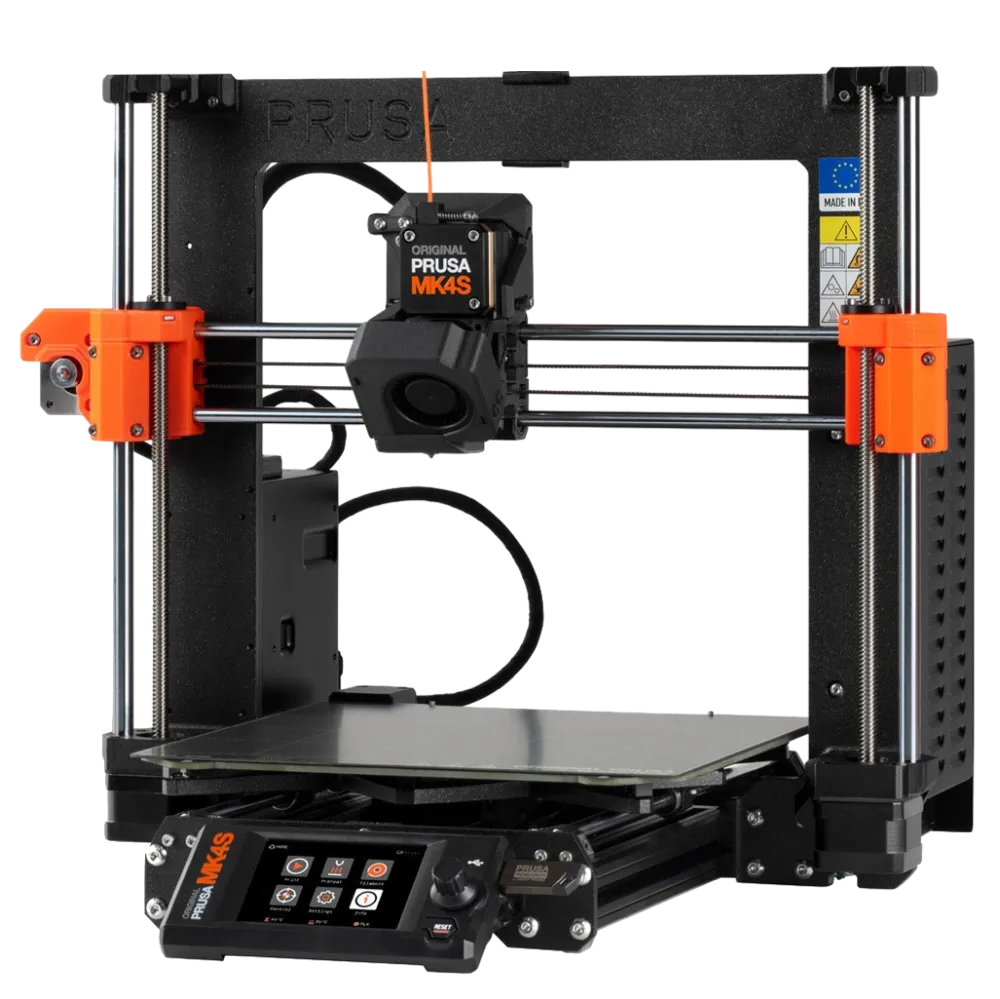
Prusa MK4S
BUYNo major lifecycle, firmware, availability, or support warnings detected.
Data refreshed: 16 May 2026
Where to buy
Specifications
- Build volume
- 250x210x220 mm
- Build size class
- Small - Shoebox
- Price
- €999 (solo)
- Enclosure
- Open frame
- Chamber control
- None
- Materials
- PLA (all variants) · PETG · PHA · TPU · TPE
- Support materials
- —
- Bowden nozzle
- —
- Max hotend temp
- 290°C
- Max bed temp
- 120°C
- Max chamber temp
- —
- Nozzle material
- Brass
- Hardened nozzle
- —
- Nozzle count
- 1
- Max filament inputs
- 5
- True multi-material
- —
- Tool change
- Single Nozzle Purge Based
Ownership
- Experience level
- Beginner-friendly
- Assembly
- Minimal
- Auto bed leveling
- Automatic
- Auto Z offset
- Yes
- Auto first layer
- Yes
- Runout sensor
- Yes
- Spaghetti detection
- —
- Error guidance
- QR Direct
- Warranty
- 12-24 months
- Spare parts
- Comprehensive
- Firmware version
- V6.5.3
Unlockable capabilities
- With hardened nozzle upgrade:
- Abrasive materials
Who this is for
For someone new to 3D printing: this printer is designed for you — it arrives nearly ready to print, handles calibration automatically before each print, and links every error to a specific step-by-step fix, meaning your day-to-day experience is printing, not troubleshooting. For a home hobbyist: the material range covers PLA, PETG, and PHA — materials that handle the great majority of home projects — and you can use any slicer software and any filament brand, with multi-color as a separately purchased add-on when you want it. For someone upgrading from an existing printer: the strong automation — calibration, error guidance, and automatic print monitoring — reduces the manual overhead of managing prints, but the shoebox build area and PLA/PETG/PHA material range mean this is a step up in ease and reliability, not an expansion of what you can make.
PrintSignals Review
Prusa MK4S Review
Assessment
The MK4S sits mid-cycle in its production life, with no visible signs of an imminent replacement — a favorable position for buyers evaluating timing. Active firmware updates confirm the manufacturer is still investing in this model. Prusa's support infrastructure is strong — warranty coverage, official channels, and documentation are all actively maintained. For buyers weighing the current window, the combined picture points toward low timing risk.
Build and print volume
The build area is shoebox-sized — enough for most everyday home and hobbyist prints, but not for large or tall objects. The open frame provides no thermal containment, exposing the print environment directly to ambient room conditions. That exposure limits the reliable material range more than the 290°C hotend or 120°C bed temperature suggest — buyers targeting materials that require a consistently warm chamber will find that constraint defined by the enclosure design, not the temperature specs.
Material capability
Multi-color printing requires a separately purchased add-on — the printer ships with a single filament input as standard. The reliable material range covers PLA in all its variants, PETG, and PHA — capable, widely-used materials for home and hobbyist printing. Abrasive filaments require a hardened nozzle upgrade, while flexible materials like TPU and TPE are hardware-supported via the direct drive extruder — though reliable results for flexibles depend on careful tuning rather than the hardware alone. Color swaps flush filament through a single nozzle, generating waste and extending print time with each added color — and because one nozzle handles all inputs, mixing incompatible materials carries cross-contamination risk.
Setup and ownership
The MK4S arrives near-fully assembled — remove a few screws and clips, and most buyers reach their first print within 15 minutes of unboxing. Day-to-day printing is designed to proceed without regular manual intervention: bed leveling, Z-offset, and first-layer calibration are all automated, and a filament runout sensor stops prints before they fail silently. When an error occurs, on-screen QR codes link to the specific fix — a practical aid for buyers without prior troubleshooting experience. At €999 mid-range, the multi-spool add-on and print failure detection are each separately purchased options, and the open platform means filament can be sourced from any manufacturer.
Support and longevity
Prusa offers a wide selection of spare parts through official channels — a meaningful asset when individual components need replacing over a 2–3 year ownership horizon. Warranty coverage spans 12 to 24 months depending on the component — long enough to cover early ownership, but once it expires, repairs fall primarily to the owner. Prusa has generally acknowledged hardware problems publicly when they arise, though resolution outcomes have been inconsistent — not every escalated issue ends with a definitive fix. After the warranty period, the open-source platform means community resources, independent modifications, and alternative parts sourcing remain accessible.