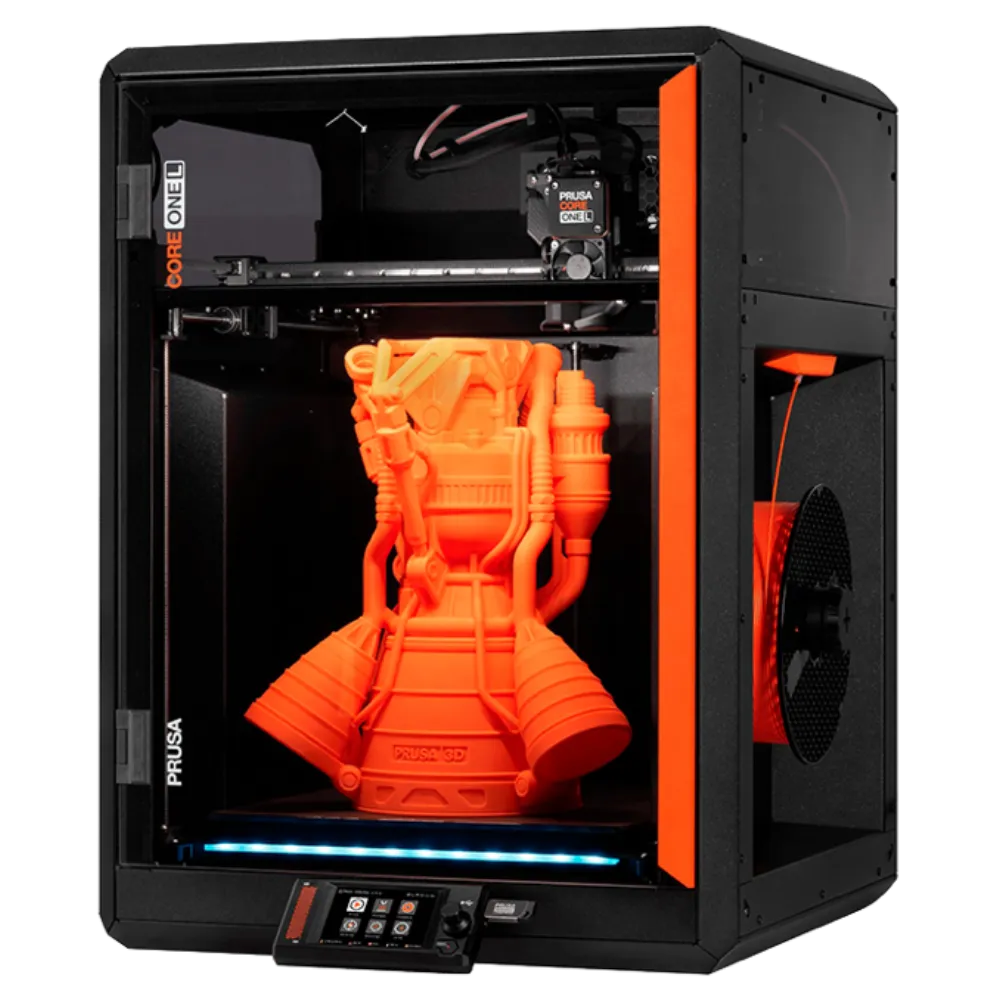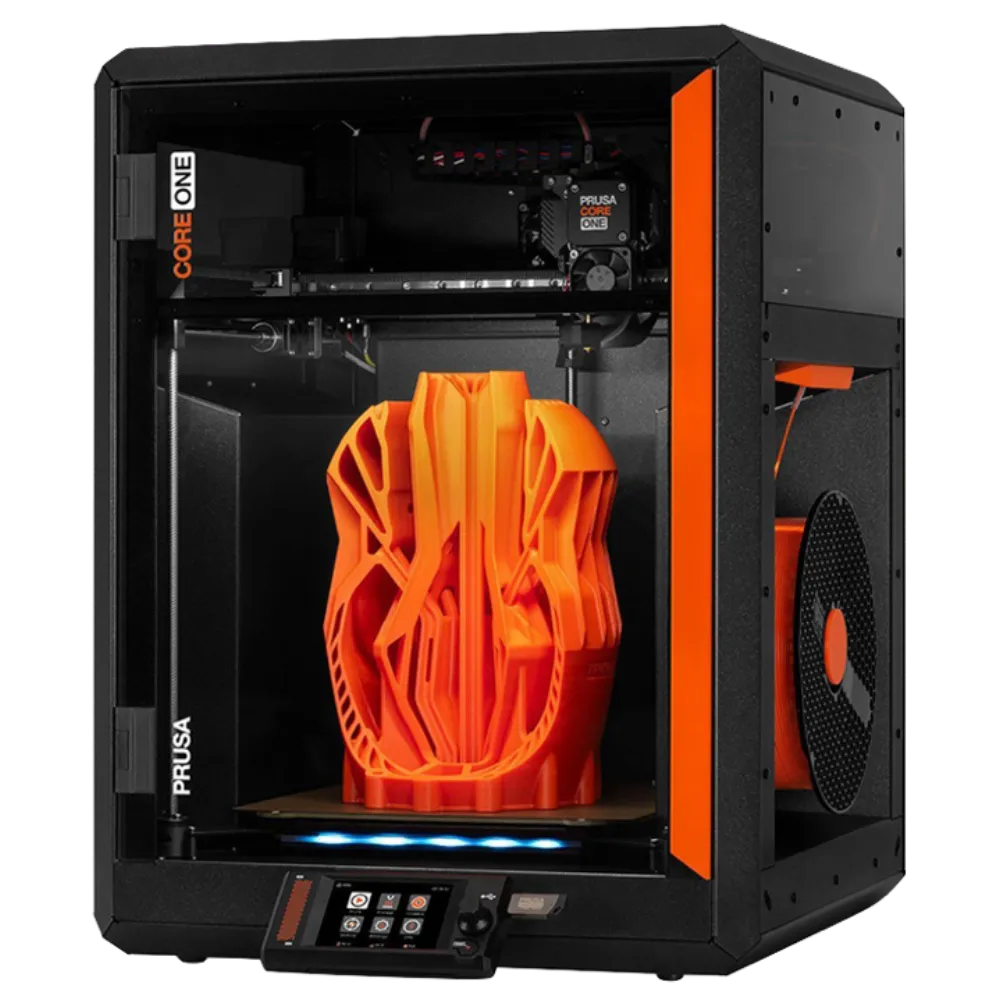
Prusa CORE One+
BUYThis printer is relatively new. Firmware cadence and support signals are still building and may not yet reflect its long-term trajectory.
Data refreshed: 16 May 2026
Where to buy
Specifications
- Build volume
- 250x220x270 mm
- Build size class
- Medium - Daypack / Backpack
- Price
- €1,349 (solo)
- Enclosure
- Full enclosure
- Chamber control
- Active Controlled Passive
- Materials
- ABS · ASA · HIPS · Nylon (PA6/PA12) · PETG · PHA · PLA (all variants) · PVB · TPU · TPC · TPE
- Support materials
- —
- Bowden nozzle
- —
- Max hotend temp
- 290°C
- Max bed temp
- 120°C
- Max chamber temp
- 55°C
- Nozzle material
- Brass
- Hardened nozzle
- —
- Nozzle count
- 1
- Max filament inputs
- 5
- True multi-material
- —
- Tool change
- Single Nozzle Purge Based
Ownership
- Experience level
- Beginner-friendly
- Assembly
- Minimal
- Auto bed leveling
- Automatic
- Auto Z offset
- Yes
- Auto first layer
- Yes
- Runout sensor
- Yes
- Spaghetti detection
- —
- Error guidance
- QR Direct
- Warranty
- 12-24 months
- Spare parts
- Comprehensive
- Firmware version
- V6.5.3
Unlockable capabilities
- With hardened nozzle upgrade:
- Abrasive materials. While Nylon-CF not possible at this tier.
Who this is for
The CORE One+ suits buyers who want an enclosed, engineering-material-capable printer without the complexity of advanced setup — the automation and documentation make it genuinely accessible to first-time owners, and the active lifecycle position means support and firmware development are ongoing. Multi-color users should weigh the purge-based swap method carefully: waste and time costs scale with color count, and mixed-material printing is not a reliable use case on this system. Buyers who need a larger build volume, abrasive filament capability without a nozzle upgrade, or hardware-native multi-material output will find meaningful limits here.
PrintSignals Review
Prusa CORE One+ Review
Assessment
The CORE One+ is early in its lifecycle with no successor on the horizon, and firmware has been updated within the last 90 days — together, these indicate a printer the manufacturer is actively investing in. Prusa's support posture across documentation, spare parts, and official channels reinforces that picture. Hardware problems, when they have arisen, have generally been acknowledged publicly, though resolution outcomes have not been consistent across all cases. For buyers weighing an enclosed printer with genuine engineering-material capability, the current position in the lifecycle reduces entry risk.
Build and print volume
The medium-size build volume — 250x220x270 mm — suits most everyday parts but is not suited to very large single-piece prints. Full enclosure provides thermal containment that enables the engineering-material range: a 120°C bed and 290°C hotend give the hardware headroom, while the enclosed cavity reduces the warping risk those materials carry on open-frame designs. Chamber temperature is actively monitored and regulated to 55°C using heat retained passively from the bed and motors, keeping power draw low but requiring approximately one hour to reach operating temperature. Buyers printing ABS, ASA, or Nylon regularly should treat that warmup window as part of the workflow, especially in cooler ambient conditions.
Material capability
Multi-color printing requires the multi-spool add-on, sold separately — the base printer ships with one filament input, and the upgrade adds up to 5 inputs with automatic spool handoff for longer prints. Color swaps are purge-based, flushing filament between changes and adding both waste and print time; this is not true multi-material — one nozzle handles all inputs, and cross-contamination limits reliable mixed-material use. The reliable range covers ABS, ASA, HIPS, Nylon (PA6/PA12), PETG, PHA, all PLA variants, and PVB; flexible filaments (TPU, TPC, TPE) are accessible via the direct drive extruder but require tuning for consistent results. Abrasive materials need a hardened nozzle upgrade, and Nylon-CF is not achievable at this tier.
Setup and ownership
The CORE One+ targets first-time 3D printer owners — prior knowledge is not assumed, and the firmware abstracts most complexity, with documentation covering most manual steps. Assembly arrives near-complete: removing holding screws, clipping a few parts, and plugging in typically takes under 15 minutes. Bed leveling, Z-offset, and first-layer calibration all run automatically, and on-screen QR codes link directly to the specific fix for each error — this makes troubleshooting concrete rather than exploratory. Filament runout is detected automatically; print failure detection requires a separately purchased add-on.
Support and longevity
Spare parts are comprehensively available through official channels, with a wide selection accessible directly from Prusa. Warranty coverage runs between 12 and 24 months depending on the component, reflecting the difference in lifecycle between consumables and structural parts. The ecosystem is fully open: open-source firmware, standard G-code, and full slicer compatibility without restriction — community modification is supported, not locked out. The CORE One+ is also officially supported by the Bondtech INDX conversion kit, an optional multi-tool upgrade that provides hardware-level multi-material capability beyond the stock single-nozzle design.