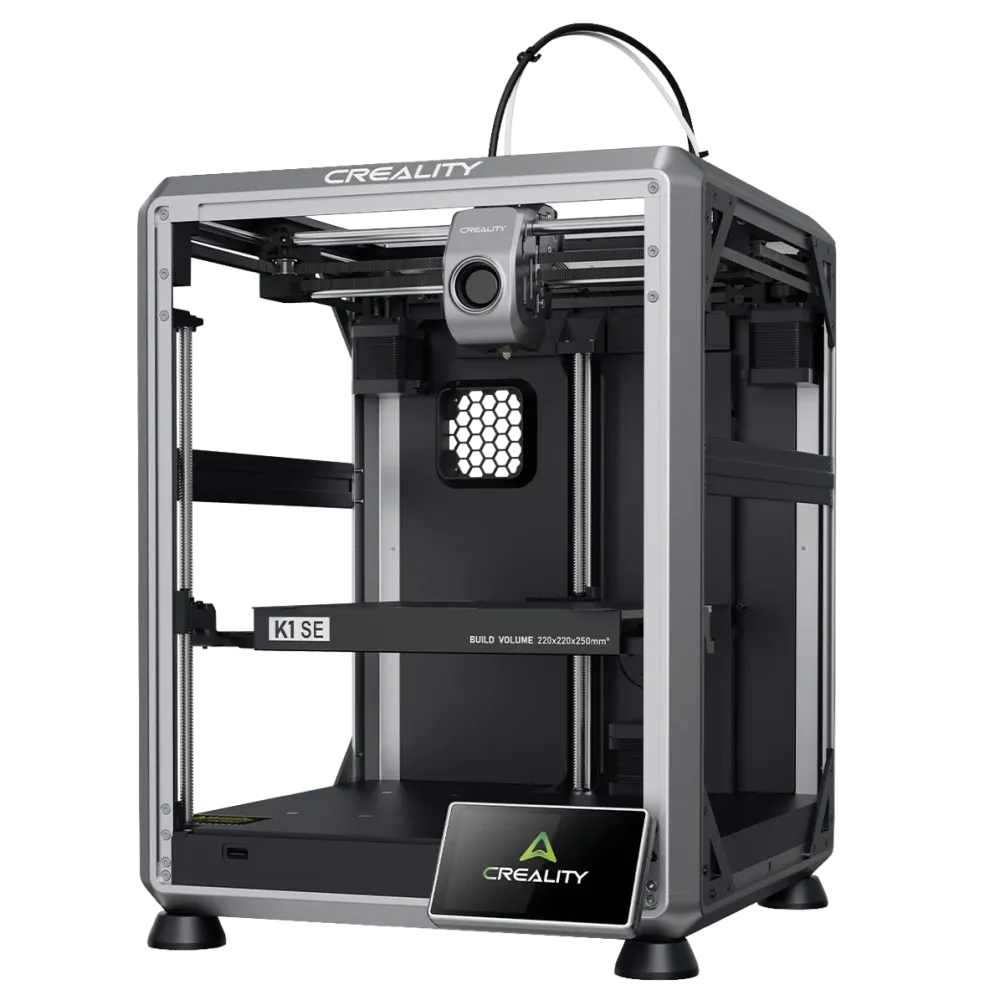
Creality K1 SE
BUYNo major lifecycle, firmware, availability, or support warnings detected.
Data refreshed: 16 May 2026
Where to buy
Specifications
- Build volume
- 220x220x250 mm
- Build size class
- Medium - Daypack / Backpack
- Price
- €289 (solo)
- Enclosure
- Open frame
- Chamber control
- None
- Materials
- PLA (all variants) · PETG · PHA · TPU · TPE
- Support materials
- —
- Bowden nozzle
- —
- Max hotend temp
- 300°C
- Max bed temp
- 100°C
- Max chamber temp
- —
- Nozzle material
- Steel
- Hardened nozzle
- —
- Nozzle count
- 1
- Max filament inputs
- 1
- True multi-material
- —
- Tool change
- Single Nozzle Pause Swap
Ownership
- Experience level
- Beginner-friendly
- Assembly
- Minimal
- Auto bed leveling
- Automatic
- Auto Z offset
- Yes
- Auto first layer
- Yes
- Runout sensor
- Yes
- Spaghetti detection
- —
- Error guidance
- Error Coded
- Warranty
- 3-12 months
- Spare parts
- Partial
- Firmware version
- 1.1.0.27
Unlockable capabilities
- With hardened nozzle upgrade:
- Abrasive materials
Who this is for
The K1 SE suits first-time buyers who want a near-ready printer with strong automation and whose projects stay within PLA, PETG, or PHA. Buyers who anticipate engineering materials, consistent multi-material printing, or long-term official manufacturer support should weigh the material and lifecycle constraints carefully. Those considering the multi-spool system should note it is a separately purchased addition.
PrintSignals Review
Creality K1 SE Review
Assessment
Firmware has been updated within the last six months, and no official replacement has been announced — both suggest the model is not abandoned. The brand's average model lifespan runs around 2.5 years, and the K1 SE is approaching that range. Current timing remains favorable, though the window for a fully active product cycle will not stay open indefinitely. Brand support quality varies across Creality's product line, which introduces some uncertainty into how consistently this model will be covered going forward.
Build and print volume
The K1 SE is built on an open frame, providing no enclosure to maintain ambient temperature around the print. The 300°C hotend and 100°C bed temperatures exceed what most common filaments require. Without thermal containment, those temperature ceilings do not expand the practical material range beyond warp-stable filaments. The medium build area of 220 × 220 × 250 mm suits most everyday hobbyist and household projects.
Material capability
A multi-spool system is available as a separately purchased option. The base printer's multi-color method is manual pause-and-swap — each color change requires physically unloading and reloading filament, with no passive automation. A single nozzle handles all material swaps, creating cross-contamination risk that limits reliable mixed-material use. The reliable range covers PLA in all variants, PETG, and PHA; flexible filaments like TPU and TPE are hardware-capable via the direct drive with careful tuning, while abrasive materials require a hardened nozzle upgrade.
Setup and ownership
This printer is designed for first-time users, arriving near-fully assembled with most buyers reaching their first print in under 15 minutes. Automatic bed leveling, Z-offset calibration, first-layer calibration, and filament runout detection address the most common friction points for new owners. Error codes display on-screen and are searchable in brand documentation, though lookup is manual rather than QR-guided. Multi-color printing and flexible filaments require hands-on attention and careful tuning — both are best approached after gaining some familiarity with the printer.
Support and longevity
Manufacturer support has generally been reliable across most dimensions. Hardware issues are the exception — official responses have shown limited transparency, with community-sourced fixes filling the gap more reliably. Spare parts for common wear items are partially available from the manufacturer, and warranty coverage spans 3 to 12 months depending on the component. The printer works with open slicer software and third-party filament; community modifications are available, though some smart features may require the manufacturer's own software or ecosystem.