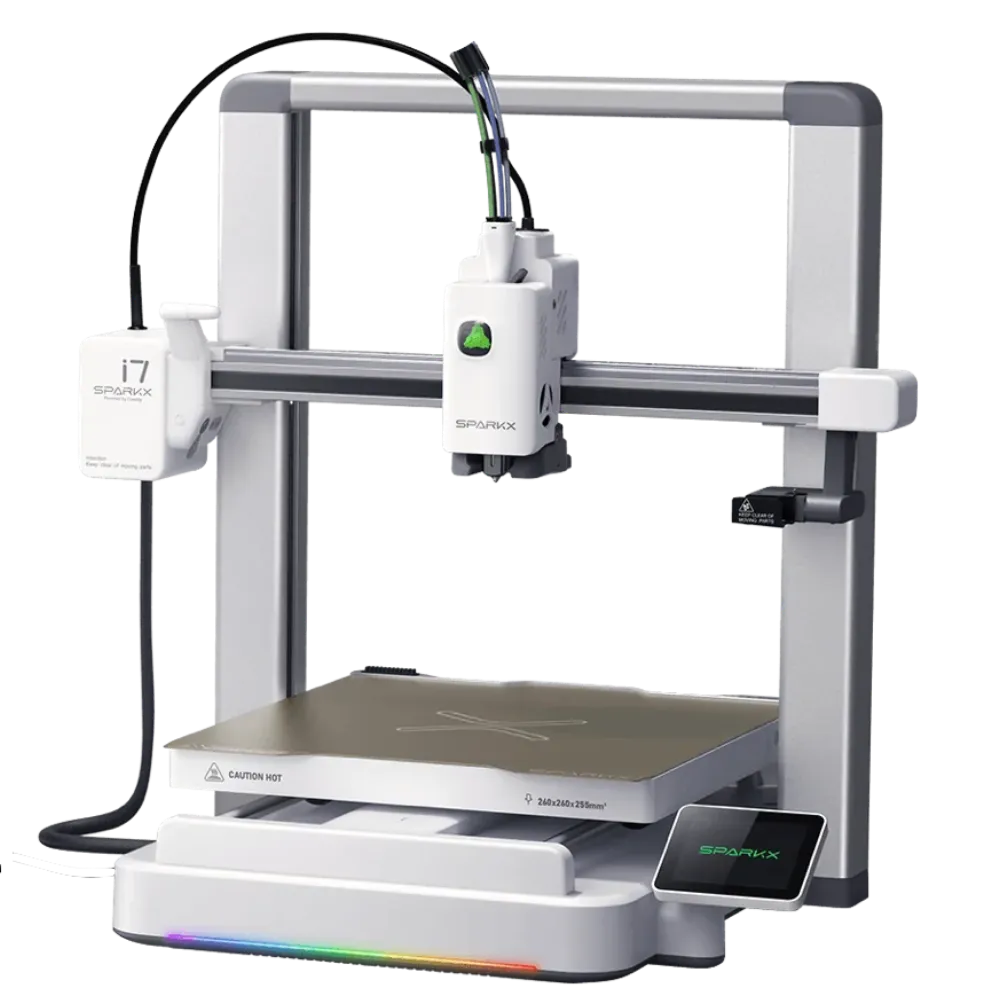
Creality SPARKX i7
BUYThis printer is relatively new. Firmware cadence and support signals are still building and may not yet reflect its long-term trajectory.
Data refreshed: 16 May 2026
Where to buy
Specifications
- Build volume
- 260x260x255 mm
- Build size class
- Medium - Daypack / Backpack
- Price
- €259 (solo)
- Enclosure
- Open frame
- Chamber control
- None
- Materials
- PLA (all variants) · PETG · PHA · TPU · TPE
- Support materials
- —
- Bowden nozzle
- —
- Max hotend temp
- 300°C
- Max bed temp
- 100°C
- Max chamber temp
- —
- Nozzle material
- Hardened Steel
- Hardened nozzle
- Included — CF/GF abrasive variants
- Nozzle count
- 1
- Max filament inputs
- 4
- True multi-material
- —
- Tool change
- Single Nozzle Purge Based
Ownership
- Experience level
- Beginner-friendly
- Assembly
- Light Build
- Auto bed leveling
- Automatic
- Auto Z offset
- Yes
- Auto first layer
- Yes
- Runout sensor
- Yes
- Spaghetti detection
- Yes
- Error guidance
- QR General
- Warranty
- 3-12 months
- Spare parts
- None
- Firmware version
- 1.1.2.4
Who this is for
This printer suits first-time buyers who want a medium-size machine for PLA, PETG, and PHA work, with the option to add multi-color printing later via the separately purchased multi-spool add-on. The direct drive makes flexible filament printing technically possible, though TPU and TPE require careful tuning. Buyers who need engineering material reliability, expect official manufacturer resolution for hardware issues, or want genuine multi-material output should look elsewhere.
PrintSignals Review
Creality SPARKX i7 Review
Assessment
The printer is recently launched with no successor announced, making timing favorable for buyers. Firmware has been updated within the last 90 days, confirming the manufacturer is actively maintaining this model. Brand support is generally reliable, though official transparency for hardware problems has been limited. Community-sourced fixes tend to fill that gap, which is worth considering for buyers who rely on direct manufacturer resolution.
Build and print volume
The 260×260×255mm build area sits in the medium-size range, providing practical capacity for multi-part assemblies and larger hobby-scale projects. The open-frame design provides no thermal containment, leaving print conditions directly exposed to ambient room temperature. The 300°C hotend and 100°C bed temperature ceilings are capable on paper. Without an enclosure to stabilize the print environment, however, the practical material range is limited to warp-stable filaments regardless of those rated limits.
Material capability
Multi-color capability requires the separately purchased multi-spool add-on, which expands filament inputs to 4 and enables automatic spool handoff during longer prints. The printer reliably handles PLA in all variants, PETG, and PHA, with the included hardened steel nozzle adding support for CF and GF abrasive blends without a nozzle change. Color swaps are managed by a single nozzle using purge-based transitions, generating filament waste and increasing print time with each color added. Cross-contamination between inputs means this is not a true multi-material system — mixing materials from different families is not reliably achievable.
Setup and ownership
The printer is designed for first-time owners, with streamlined firmware and well-documented guidance for most situations, though occasional manual steps remain part of the workflow. Setup requires minor mechanical assembly, typically completed in 15 to 45 minutes. Automation handles bed leveling, Z-offset calibration, first-layer calibration, filament runout detection, and print failure detection, reducing the manual attention needed day-to-day. When errors occur, on-screen QR codes link to a general error page rather than the specific fix, requiring some navigation to find the relevant resolution.
Support and longevity
Replacement components will need to be sourced from third-party suppliers or community channels, as no official spare parts are listed on the manufacturer's storefront. Warranty coverage runs 3 to 12 months depending on the component, reflecting that protection periods vary by part. The ecosystem is semi-open, supporting open slicers, third-party filament, and community modifications. Some smart features or integrations may require the manufacturer's own software, which is worth noting for buyers who prefer a fully independent setup.