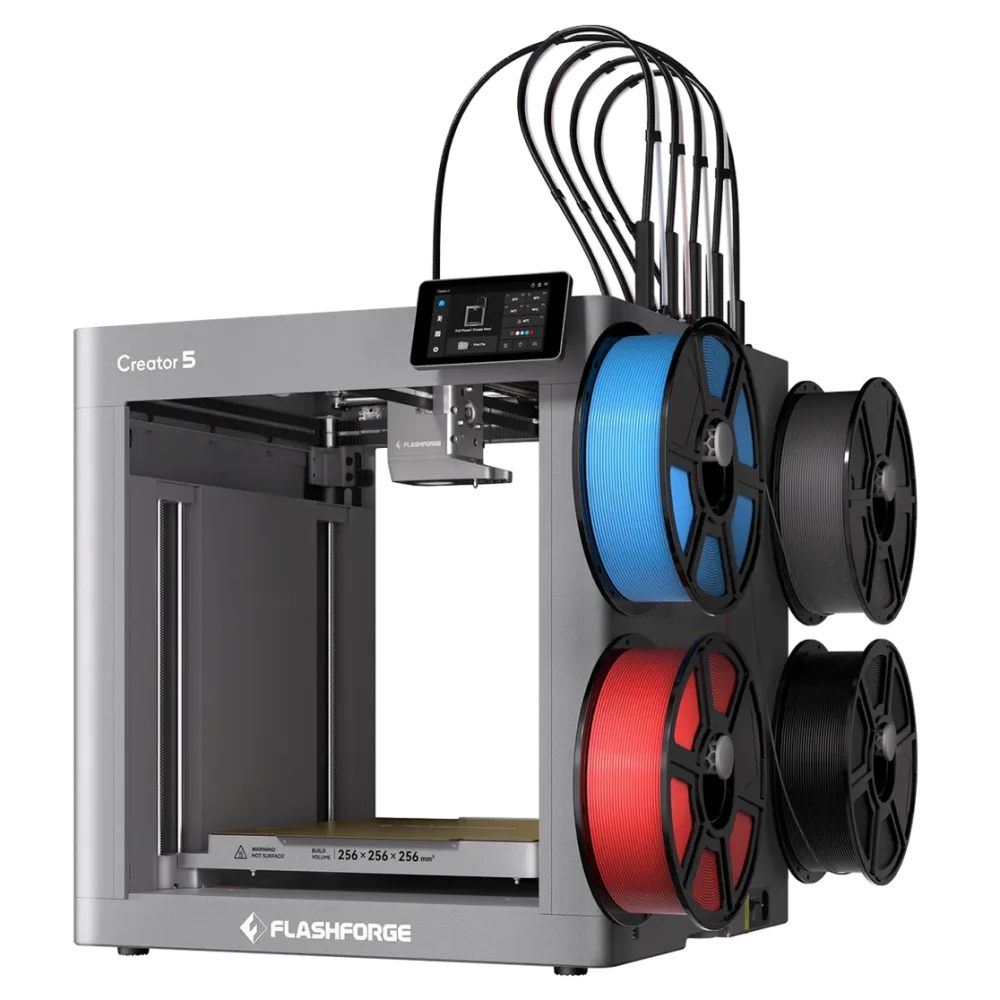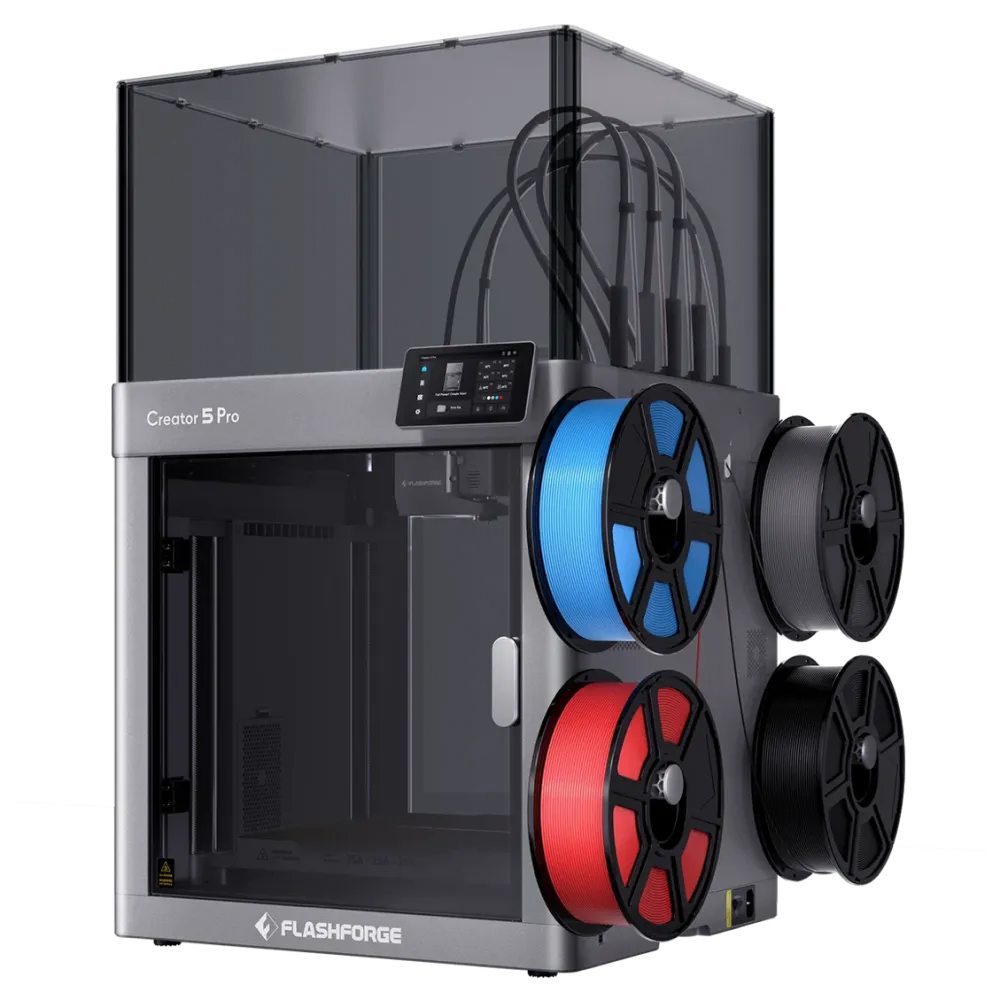
Flashforge Creator 5 Pro
WAITThis printer is relatively new. Firmware cadence and support signals are still building and may not yet reflect its long-term trajectory.
Data refreshed: 16 May 2026
Where to buy
Specifications
- Build volume
- 256x256x256 mm
- Build size class
- Medium - Daypack / Backpack
- Price
- €949 (combo)
- Enclosure
- Full enclosure
- Chamber control
- Active Controlled
- Materials
- ABS · ASA · HIPS · Nylon (PA6/PA12) · PC · PC-ABS · PETG · PHA · PLA (all variants) · PVB · TPU · TPC · TPE
- Support materials
- PVA · PVOH · BVOH as simultaneous support material
- Bowden nozzle
- —
- Max hotend temp
- 320°C
- Max bed temp
- 120°C
- Max chamber temp
- 65°C
- Nozzle material
- Brass
- Hardened nozzle
- —
- Nozzle count
- 4
- Max filament inputs
- 4
- True multi-material
- Yes
- Tool change
- Tool Changer Pause Swap
Ownership
- Experience level
- Intermediate
- Assembly
- Light Build
- Auto bed leveling
- Automatic
- Auto Z offset
- Yes
- Auto first layer
- Yes
- Runout sensor
- Yes
- Spaghetti detection
- Yes
- Error guidance
- Error Coded
- Warranty
- 3-12 months
- Spare parts
- Minimal
- Firmware version
- —
Unlockable capabilities
- With hardened nozzle upgrade:
- Abrasive materials · Nylon-CF possible with upgrade. While PC-CF not possible at this tier.
Who this is for
This printer is suited to users with some 3D printing experience who want simultaneous multi-material capability alongside a genuine engineering material range in a mid-size format. This review should be treated as a directional indicator only — announced specifications describe intention, not delivered performance, and post-launch reviews will be the appropriate point to make a purchase decision. Buyers whose needs center on single-material PLA or PETG printing will find the complexity and cost of this configuration exceed what their workflow requires.
PrintSignals Review
Flashforge Creator 5 Pro Review
Assessment
This printer has not yet been released — everything below is based on announced specifications, which may still change before or at launch. The announced configuration points toward an enclosed, active-chamber machine with four dedicated toolheads and a broad engineering material range. A better purchase window may arrive soon after launch — through a price correction, early firmware refinements, or simply the accumulation of real-world performance data that cannot yet exist. Committing before that data exists means accepting a level of uncertainty that waiting a few weeks or months after release could meaningfully reduce.
Build and print volume
The 256×256×256 mm build volume places this in the mid-size class, covering a practical range of project sizes without reaching large-format territory. Full enclosure with an actively controlled chamber — announced at 65°C — is what makes reliable engineering material printing achievable rather than merely possible. A 320°C hotend ceiling and 120°C bed temperature address the sustained heat demands of ABS, ASA, PC, and Nylon, which an open-frame or passively enclosed machine cannot consistently provide.
Material capability
The announced reliable material range covers PLA, PETG, ABS, ASA, HIPS, Nylon (PA6/PA12), PC, PC-ABS, PHA, and PVB. The stock brass nozzle limits abrasive filament use — a hardened nozzle upgrade opens Nylon-CF, though PC-CF is not achievable at this nozzle tier. The direct drive extruder enables flexible filaments including TPU, TPC, and TPE, though these require tuning beyond hardware setup alone. The four dedicated toolheads support simultaneous multi-material printing and unlock PVA, PVOH, and BVOH as dissolvable support options. Each color change pauses the print and requires operator presence, though announced swap times are fast and material waste is very low.
Setup and ownership
Some prior 3D printing experience will help — the four-toolhead workflow and engineering material range introduce variables that are easier to manage with an existing baseline. Assembly is minor, typically 15–45 minutes. The bundled four-spool configuration enables automatic filament handoff when a spool runs out, and automation further covers bed leveling, Z-offset calibration, first-layer calibration, and print failure detection. The firmware is documented and guidance is available for most situations, though error codes require manual wiki lookup rather than a QR scan.
Support and longevity
No real-world track record exists for support quality, warranty handling, or spare parts availability — none of this can be assessed before the printer ships and reaches users. The ecosystem is semi-open: open slicers and third-party filament are compatible, and community modifications are available, which provides long-term flexibility independent of the manufacturer. Some smart features or integrations may require Flashforge's own software. How the brand handles early firmware issues and user queries after launch will be the first meaningful indicator of actual support quality.