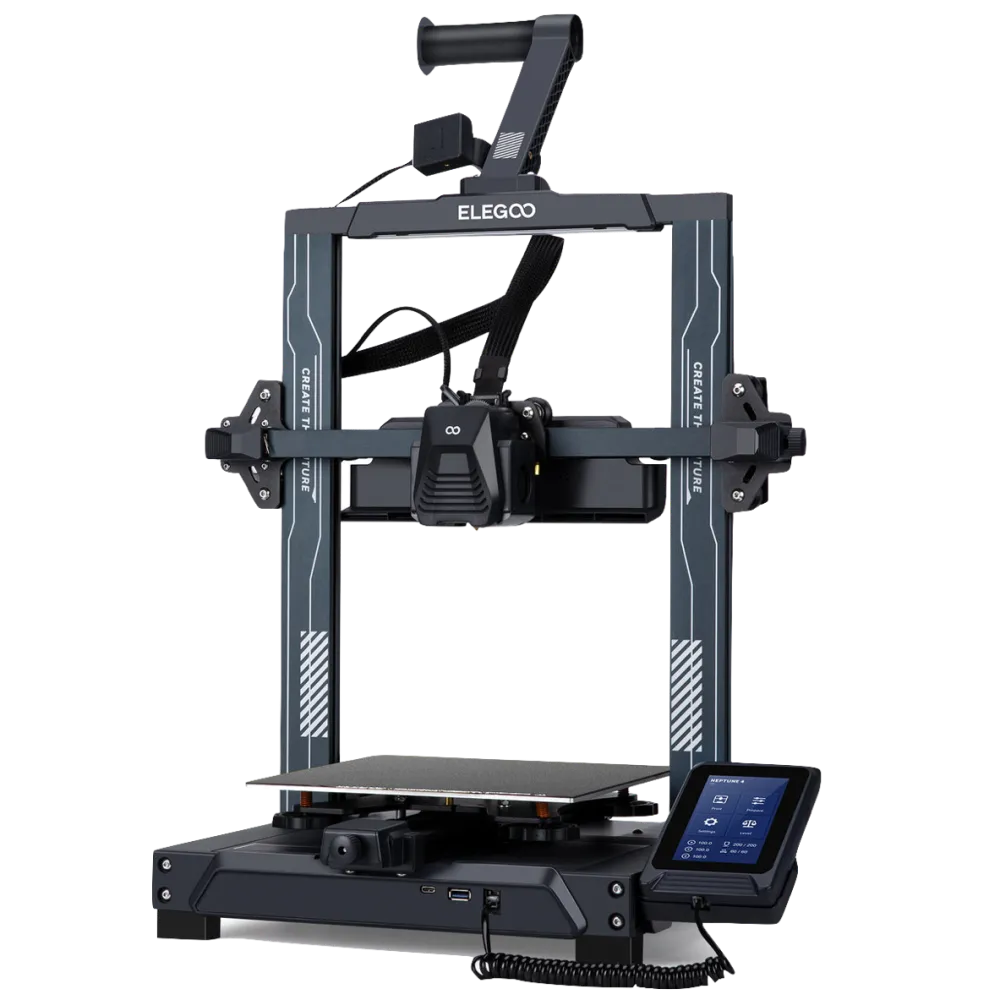
Elegoo Neptune 4
CAUTIONThis printer appears overdue for replacement, refresh, or discontinuation. If found at a strong discount and the printer still fits your needs, it may be worth comparing against newer alternatives. Support signals are limited across one or more tracked areas such as documentation, spare parts access, repair guidance, or support visibility.
Data refreshed: 16 May 2026
Where to buy
Specifications
- Build volume
- 225x225x265 mm
- Build size class
- Medium - Daypack / Backpack
- Price
- €179 (solo)
- Enclosure
- Open frame
- Chamber control
- None
- Materials
- PLA (all variants) · PETG · PHA · TPU · TPE
- Support materials
- —
- Bowden nozzle
- —
- Max hotend temp
- 300°C
- Max bed temp
- 110°C
- Max chamber temp
- —
- Nozzle material
- Brass
- Hardened nozzle
- —
- Nozzle count
- 1
- Max filament inputs
- 1
- True multi-material
- —
- Tool change
- Single Nozzle Pause Swap
Ownership
- Experience level
- Tinkerer
- Assembly
- Light Build
- Auto bed leveling
- Assisted
- Auto Z offset
- —
- Auto first layer
- —
- Runout sensor
- Yes
- Spaghetti detection
- —
- Error guidance
- Generic
- Warranty
- 3-6 months
- Spare parts
- Minimal
- Firmware version
- V1.3.1.4
Unlockable capabilities
- With hardened nozzle upgrade:
- Abrasive materials
Who this is for
The Neptune 4 suits experienced makers who are comfortable with Klipper, willing to invest time in tuning, and able to navigate community resources when things go wrong. Buyers who want current-generation hardware, reliable official support, or simplified error handling will find a better match elsewhere.
PrintSignals Review
Elegoo Neptune 4 Review
Assessment
The Neptune 4 has received firmware updates within the last 90 days, and the manufacturer has generally kept replaced models receiving continued support. That support history is limited in scope and should be read as a reassuring sign, not a guarantee of long-term continuity. The deeper concern is timing: this model sits well past the typical replacement window for this brand's lineup, which averages around 1.2 years per model. That is a pattern-based observation, not an official discontinuation announcement. The AVOID verdict reflects this lifecycle position, not a technical fault in the hardware itself.
Build and print volume
The medium build area of 225 × 225 × 265 mm handles mid-size parts comfortably. The open-frame design provides no thermal containment — the printing environment is ambient room temperature, not a controlled enclosure. The hotend reaches 300°C and the bed 110°C, but those figures describe hardware capability, not reliable material range. Materials that require a stable heated environment fall outside what an open-frame setup can reliably deliver, regardless of the temperature ceiling.
Material capability
Multi-color printing uses a single nozzle with manual pause-and-swap. Each color change requires physically unloading and reloading filament — active intervention at every transition, not passive monitoring. The single-nozzle design means cross-contamination applies at every swap, limiting reliable mixed-material combinations. The reliable range covers PLA in all variants, PETG, and PHA. The stock brass nozzle is not hardened, making abrasive filaments dependent on a separately purchased hardened nozzle. The direct drive extruder provides hardware capability for TPU and TPE, though flexible materials are technically demanding and results depend significantly on tuning.
Setup and ownership
This printer demands a tinkerer mindset, running Klipper-based firmware where calibration, tuning, and occasional debugging are expected parts of ownership. Assembly involves minor mechanical setup, typically 15 to 45 minutes. Once configured, assisted bed leveling and filament runout detection ease day-to-day use. Error messages are generic text or raw firmware output, leaving independent diagnosis as the primary troubleshooting path.
Support and longevity
The warranty runs 3 to 6 months depending on component — a narrow window that limits early hardware protection. Official spare parts availability is minimal. Items not listed in the store may be obtainable by contacting manufacturer support directly, though outcomes vary. When hardware problems arise, official communication tends to be limited, and community resources typically fill the gap. The ecosystem is fully open — Klipper-compatible firmware, standard G-code, and no slicer restrictions — allowing free modification and extension without manufacturer permission.