Elegoo Centauri Carbon 2
BUYThis printer is relatively new. Firmware cadence and support signals are still building and may not yet reflect its long-term trajectory.
Data refreshed: 16 May 2026
Where to buy
Specifications
- Build volume
- 256x256x256 mm
- Build size class
- Medium - Daypack / Backpack
- Price
- €439 (combo)
- Enclosure
- Full enclosure
- Chamber control
- None
- Materials
- ABS · ASA · HIPS · Nylon (PA6/PA12) · PETG · PHA · PLA (all variants) · PVB · TPU · TPC · TPE
- Support materials
- —
- Bowden nozzle
- —
- Max hotend temp
- 350°C
- Max bed temp
- 110°C
- Max chamber temp
- —
- Nozzle material
- Brass-Hardened Steel
- Hardened nozzle
- Included — CF/GF abrasive variants. While Nylon-CF not possible at this tier.
- Nozzle count
- 1
- Max filament inputs
- 4
- True multi-material
- —
- Tool change
- Single Nozzle Purge Based
Ownership
- Experience level
- Beginner-friendly
- Assembly
- Light Build
- Auto bed leveling
- Automatic
- Auto Z offset
- Yes
- Auto first layer
- Yes
- Runout sensor
- Yes
- Spaghetti detection
- Yes
- Error guidance
- Error Coded
- Warranty
- 3-6 months
- Spare parts
- Partial
- Firmware version
- V1.3.2.36
Who this is for
The Centauri Carbon 2 suits buyers who want an enclosed, automation-ready printer capable of PLA, PETG, ABS, ASA, and Nylon without requiring prior experience. Multi-color printing is bundled and accessible to beginners, though the single-nozzle purge method is slow and generates waste by design. Buyers who need high-throughput color output or reliable mixed-material printing will find the system limiting.
PrintSignals Review
Elegoo Centauri Carbon 2 Review
Assessment
The Centauri Carbon 2 sits early in its lifecycle with no successor visible, and firmware has been updated within the last 90 days. Both confirm the manufacturer remains actively engaged with this model. Brand support is reliable across most dimensions, though when hardware problems arise, official responses have shown limited transparency. Community-sourced fixes tend to fill that gap, which is worth knowing before committing.
Build and print volume
The 256×256×256 mm build area is medium-size, suited for most single-piece parts and mid-size functional prints. Full enclosure provides thermal containment, reducing warping risk for materials like ABS, ASA, and Nylon that open-frame designs cannot reliably support. A 350°C hotend and 110°C bed give the hardware enough thermal headroom to work across the full material range. The chamber is not actively heated — temperature inside builds passively from the bed and motors rather than from a dedicated control system.
Material capability
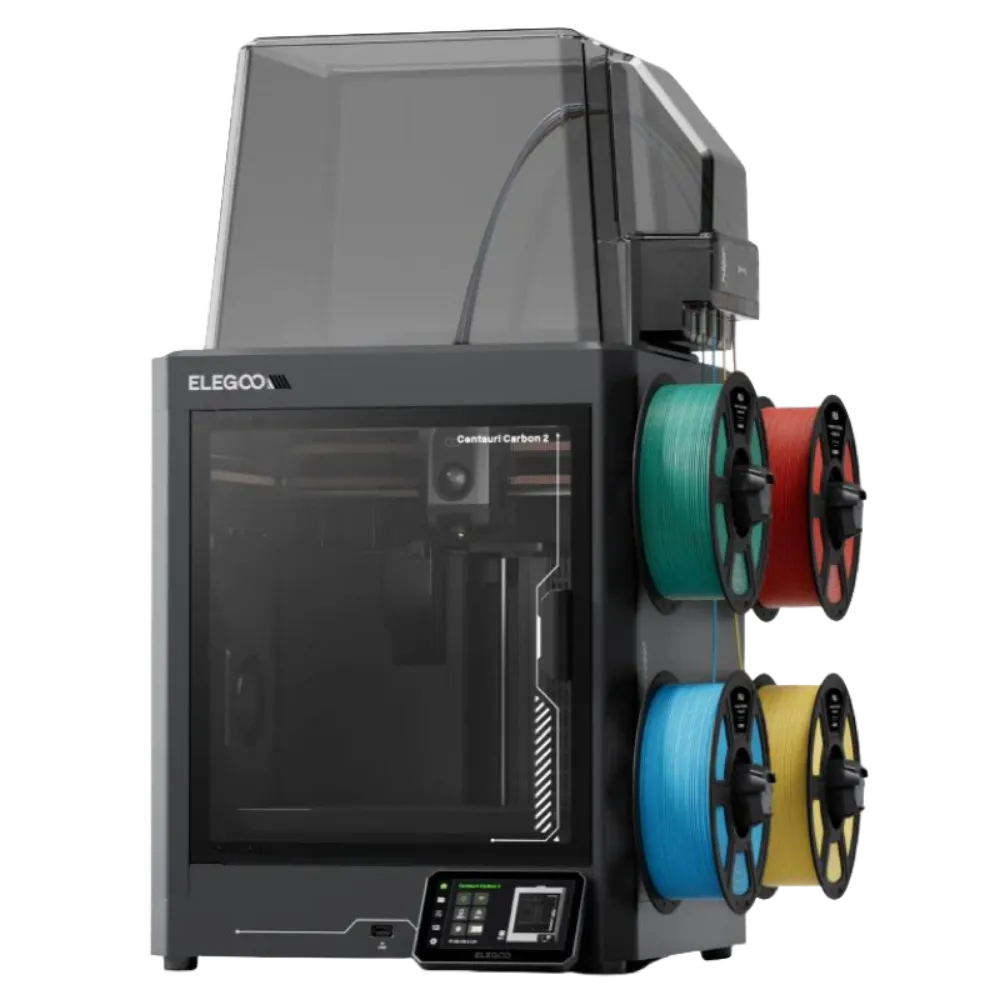
Multi-color capability is bundled with the printer's 4-input spool system, which also handles automatic filament handoff when a spool runs out, keeping long prints running without interruption. Color swaps use a single nozzle with purge-based flushing, generating waste and increasing print time with each additional color. Mixed-material combinations are limited by cross-contamination risk at a shared nozzle. The reliable range covers PLA variants, PETG, PHA, PVB, ABS, ASA, HIPS, and Nylon PA6/PA12, with CF and GF abrasive filaments also within the included nozzle's capability, though Nylon-CF is not. Flexible materials including TPU, TPC, and TPE are hardware-capable via direct drive but require tuning for consistent results.
Setup and ownership
This printer is designed for first-time buyers, with minimal prior knowledge required and well-documented guidance available for most situations. Assembly is minor, typically completed in 15 to 45 minutes. The automation suite covers automatic bed leveling, Z-offset calibration, first-layer calibration, filament runout detection, and print failure detection. Error codes appear on screen with numbers searchable through the brand wiki, though lookup is manual as no QR code is provided.
Support and longevity
Spare parts availability is partial, with some common wear items accessible through the manufacturer's store but not a comprehensive selection. Warranty coverage runs 3 to 6 months depending on the component, which sits on the shorter end for a printer in this class. The printer is compatible with major open slicers and third-party filaments, with community modifications also accessible. Some smart features or integrations may require the manufacturer's own software rather than fully open tools.