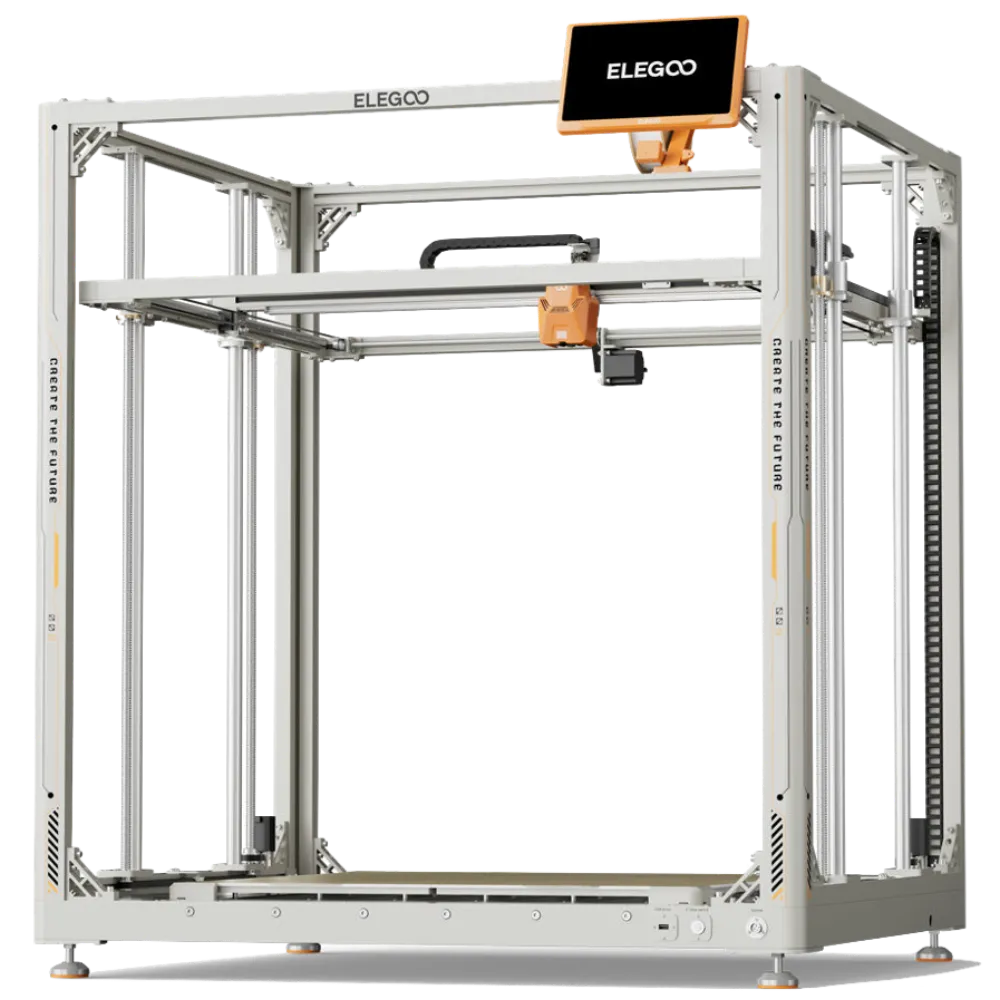
Elegoo OrangeStorm Giga
CAUTIONThis printer appears overdue for replacement, refresh, or discontinuation. If found at a strong discount and the printer still fits your needs, it may be worth comparing against newer alternatives. Support signals are limited across one or more tracked areas such as documentation, spare parts access, repair guidance, or support visibility.
Data refreshed: 16 May 2026
Where to buy
Specifications
- Build volume
- 800x800x1000 mm
- Build size class
- Massive - Appliance / Small Fridge
- Price
- €2,749 (solo)
- Enclosure
- Open frame
- Chamber control
- None
- Materials
- PLA (all variants) · PETG · PHA · TPU · TPE
- Support materials
- —
- Bowden nozzle
- —
- Max hotend temp
- 300°C
- Max bed temp
- 100°C
- Max chamber temp
- —
- Nozzle material
- Brass
- Hardened nozzle
- —
- Nozzle count
- 1
- Max filament inputs
- 4
- True multi-material
- —
- Tool change
- Single Nozzle Purge Based
Ownership
- Experience level
- Tinkerer
- Assembly
- Extended Build
- Auto bed leveling
- Assisted
- Auto Z offset
- —
- Auto first layer
- —
- Runout sensor
- Yes
- Spaghetti detection
- —
- Error guidance
- Generic
- Warranty
- 3-6 months
- Spare parts
- Minimal
- Firmware version
- V2.3.2.6
Unlockable capabilities
- With hardened nozzle upgrade:
- Abrasive materials
Who this is for
The OrangeStorm Giga is suited to experienced makers with a specific, immediate need for an 800×800×1000 mm build area who are comfortable with Klipper-based ownership, including tuning, troubleshooting, and community-reliant support. Buyers without a defined large-format use case in PLA or PETG should not commit at this lifecycle stage, when a successor is statistically overdue and official support infrastructure is limited. Anyone newer to 3D printing, or expecting manufacturer-level transparency when problems arise, will find this printer a difficult ownership experience.
PrintSignals Review
Elegoo OrangeStorm Giga Review
Assessment
Firmware has been updated within the last 90 days, and the manufacturer has a track record of keeping active models supported — both suggest this printer is not currently abandoned. The concern is timing: this model sits well past the expected replacement window for its brand, which historically averages about 1.2 years per model. That is a pattern-based read, not an official announcement, but it reflects a genuine statistical probability that a successor is close. At this price and lifecycle stage, a clear and immediate use case is the minimum threshold a buyer should apply.
Build and print volume
The build volume at 800×800×1000 mm accommodates objects the size of a small appliance in a single print — useful for large PLA or PETG parts where splitting a model across multiple runs would otherwise be required. The open-frame design means the print environment is exposed to ambient conditions throughout the print. The hotend reaches 300°C and the bed reaches 100°C, but without thermal containment those temperatures cannot compensate for airflow or temperature variation in the room.
Material capability
The reliable material range covers PLA in all variants, PETG, and PHA. The direct drive extruder adds hardware support for flexible filaments including TPU and TPE, though results are tuning-dependent rather than automatic. Printing abrasive materials requires a separately purchased hardened nozzle. Multi-color capability uses single-nozzle purge-based swaps — slow and waste-generating per color change, with the shared nozzle limiting reliable mixed-material use.
Setup and ownership
Assembly requires building the printer from sections — expect 45 to 120 minutes and some mechanical familiarity. Assisted bed leveling and filament runout detection reduce routine overhead once operational. Klipper-based firmware gives experienced users significant configurability, but tuning, calibration, and debugging are ongoing and expected parts of ownership. Error messages are generic or raw firmware output with no structured code system — diagnosing problems requires independent effort or community resources.
Support and longevity
The warranty runs 3 to 6 months depending on the component. Official spare parts availability is minimal — a limited selection appears in the official store, and items not listed may require contacting the manufacturer directly. When hardware problems arise, official guidance tends to be limited in transparency, with community-sourced diagnostics typically filling the gap. The fully open ecosystem — compatible with any slicer, standard G-code, and open-source firmware — means long-term ownership has a strong community foundation to draw on.