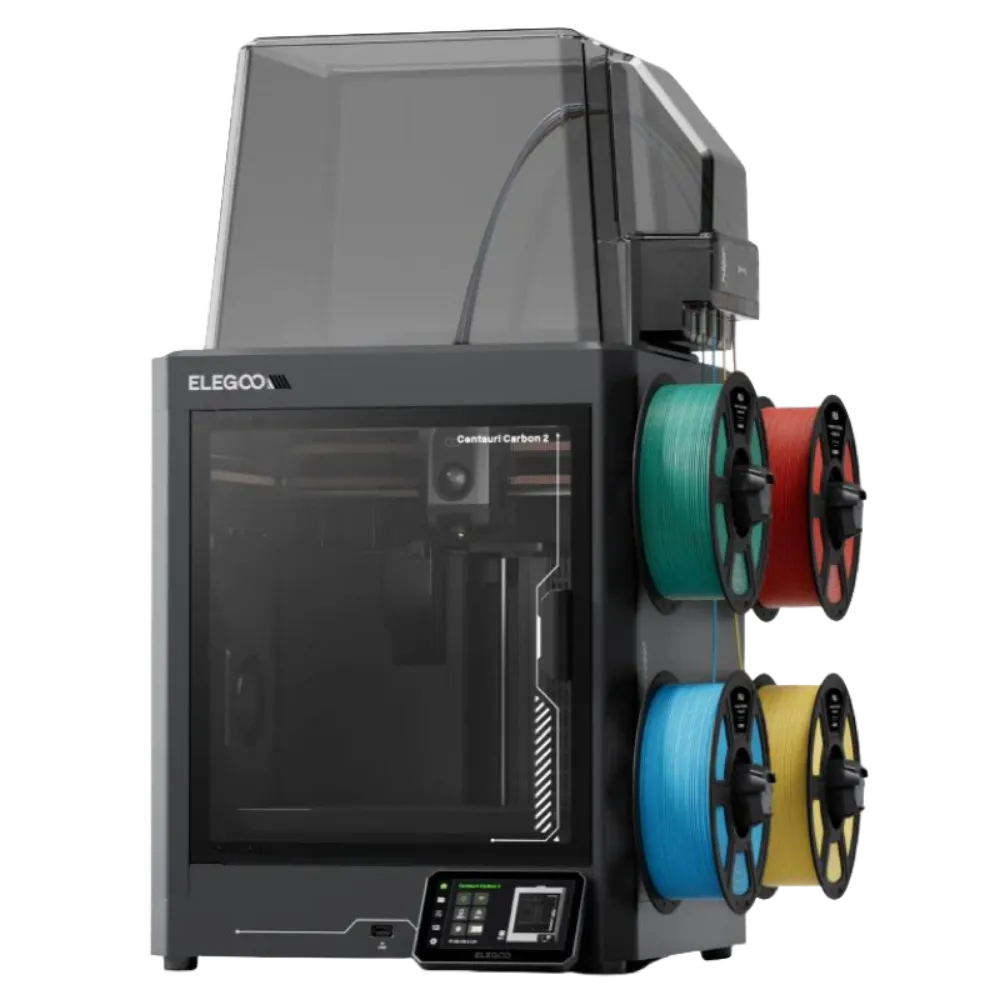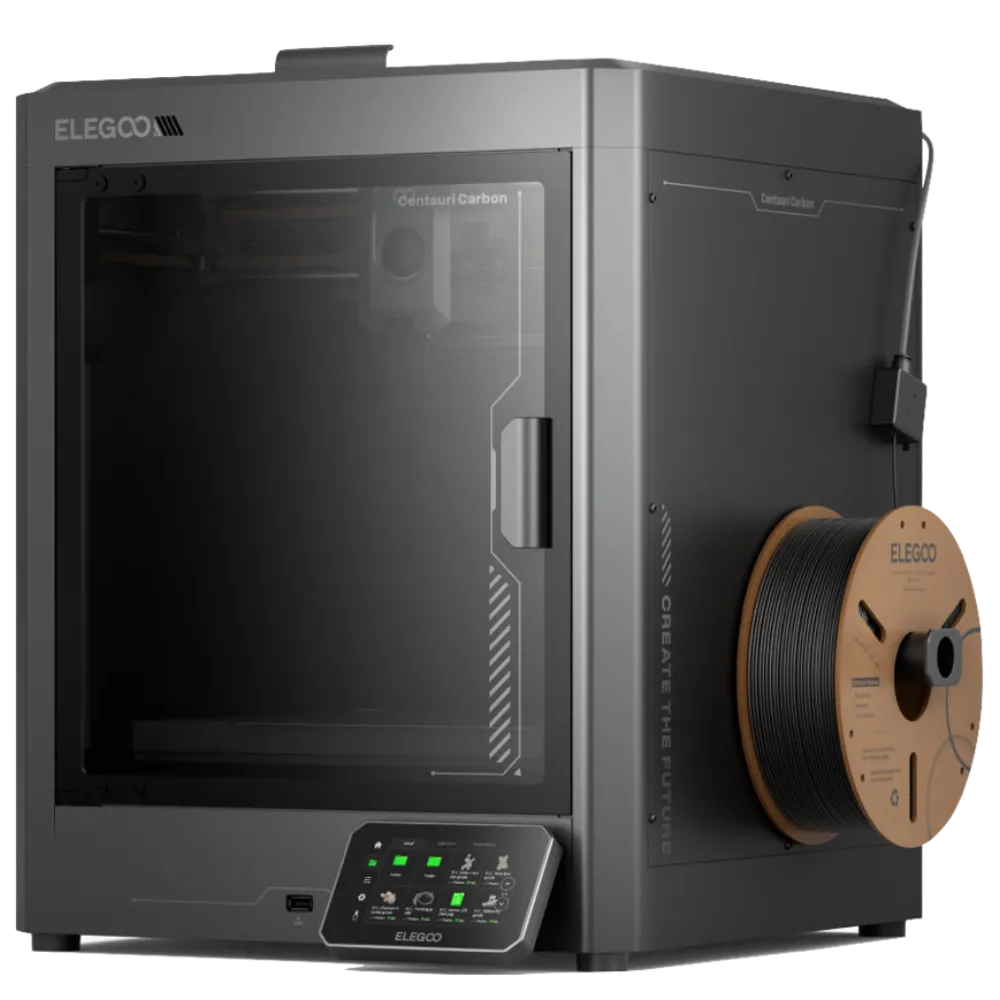
Elegoo Centauri Carbon
CAUTIONThis printer appears late in its lifecycle, so long-term support, parts availability, or resale value may weaken over time. If found at a strong discount and the printer still fits your needs, it may be worth comparing against newer alternatives.
Data refreshed: 16 May 2026
Where to buy
Specifications
- Build volume
- 256x256x256 mm
- Build size class
- Medium - Daypack / Backpack
- Price
- €309 (solo)
- Enclosure
- Full enclosure
- Chamber control
- None
- Materials
- ABS · ASA · HIPS · Nylon (PA6/PA12) · PETG · PHA · PLA (all variants) · PVB · TPU · TPC · TPE
- Support materials
- —
- Bowden nozzle
- —
- Max hotend temp
- 320°C
- Max bed temp
- 110°C
- Max chamber temp
- —
- Nozzle material
- Brass-Hardened Steel
- Hardened nozzle
- Included — CF/GF abrasive variants. While Nylon-CF not possible at this tier.
- Nozzle count
- 1
- Max filament inputs
- 4
- True multi-material
- —
- Tool change
- Single Nozzle Purge Based
Ownership
- Experience level
- Beginner-friendly
- Assembly
- Minimal
- Auto bed leveling
- Automatic
- Auto Z offset
- Yes
- Auto first layer
- Yes
- Runout sensor
- Yes
- Spaghetti detection
- Yes
- Error guidance
- Error Coded
- Warranty
- 3-6 months
- Spare parts
- Partial
- Firmware version
- V1.4.46
Who this is for
The Centauri Carbon suits first-time buyers who want an enclosed printer with genuine engineering material capability — ABS, ASA, and Nylon — without the complexity that often accompanies that material range. The lifecycle position and short warranty make it a less confident choice for buyers who prioritize long-term support certainty or plan to depend on this machine heavily over two or more years. Those specifically seeking true multi-material capability or active chamber control for demanding high-temperature work will find this printer's single-nozzle design and passive chamber a meaningful limitation.
PrintSignals Review
Elegoo Centauri Carbon Review
Assessment
Recent firmware updates confirm the brand is still actively supporting this model, consistent with its generally positive observed support posture. The concern is timing: statistically, most models in this brand's lineup reach reduced support at approximately 1.2 years, and the Centauri Carbon sits past that threshold. No official discontinuation has been announced — this is a risk pattern, not a confirmed endpoint. Buyers who plan long-term ownership should account for the possibility that support activity and updates may narrow over time.
Build and print volume
The 256x256x256mm build area is a medium-size footprint — large enough for most household and hobbyist projects, but not for oversized functional parts in a single run. Full enclosure provides genuine thermal containment, reducing warping risk and enabling reliable use of engineering materials that open-frame printers cannot handle dependably. The chamber retains passive heat from the bed and motors but is not actively regulated, meaning sustained high-temperature printing depends on ambient conditions rather than controlled chamber heat. The 320°C hotend and 110°C bed cover the temperature requirements of the full material range this printer supports.
Material capability
Multi-color capability requires the separately purchased multi-spool system. Color changes are purge-based — filament is flushed between each swap, generating waste and raising both print time and filament cost as color count grows. This is a single-nozzle design rather than true multi-material: cross-contamination risk applies to any material combination, limiting reliable mixed-material use. The material range spans PLA, PETG, ABS, ASA, HIPS, Nylon (PA6/PA12), PHA, and PVB, with CF and GF composites also within reach — Nylon-CF is not — and the direct drive extruder adds flexible filament support, though TPU-class materials require careful tuning.
Setup and ownership
This printer is designed for first-time owners — the firmware is abstracted to minimize required knowledge, and most situations have documented guidance available. Assembly is near-fully completed at the factory, with setup typically taking under 15 minutes from box to first print. The automation package is comprehensive: automatic bed leveling, Z-offset calibration, first-layer calibration, filament runout detection, and print failure detection all reduce the daily skill requirement significantly. Error codes are numbered and searchable on the brand wiki, though there is no QR code on the machine — any error requires a manual lookup rather than a quick scan.
Support and longevity
Elegoo's support is generally reliable across most dimensions — a meaningful baseline for a printer at this price point. When hardware problems arise, official responses have shown limited transparency, and community-sourced fixes tend to be the more practical resolution path. The warranty runs 3 to 6 months depending on the component, and spare parts availability through official channels is partial, covering some common wear items. The ecosystem is semi-open: standard slicers and third-party filament are compatible, community modifications exist, and some smart features may require Elegoo's own software.