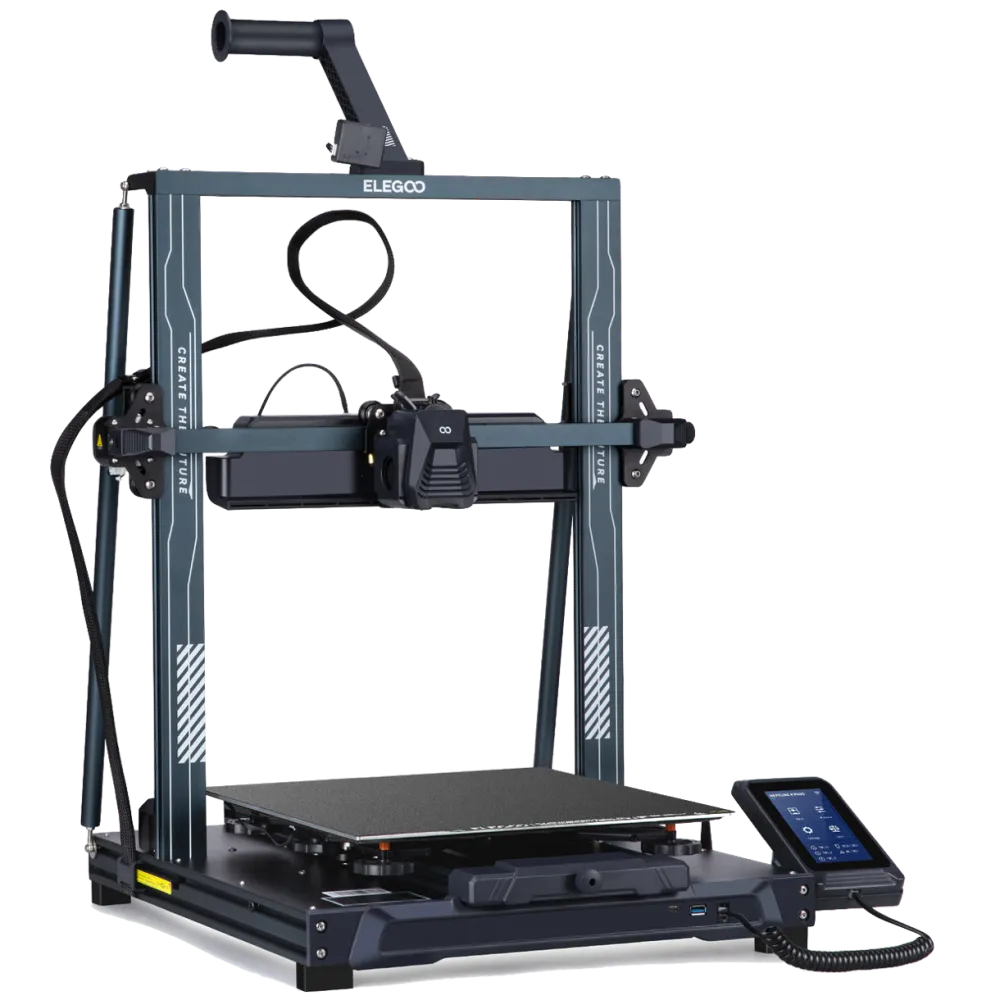
Elegoo Neptune 4 Plus
CAUTIONThis printer appears overdue for replacement, refresh, or discontinuation. If found at a strong discount and the printer still fits your needs, it may be worth comparing against newer alternatives. Support signals are limited across one or more tracked areas such as documentation, spare parts access, repair guidance, or support visibility.
Data refreshed: 16 May 2026
Where to buy
Specifications
- Build volume
- 320x320x385 mm
- Build size class
- Large - Carry-on Suitcase
- Price
- €289 (solo)
- Enclosure
- Open frame
- Chamber control
- None
- Materials
- PLA (all variants) · PETG · PHA · TPU · TPE
- Support materials
- —
- Bowden nozzle
- —
- Max hotend temp
- 300°C
- Max bed temp
- 100°C
- Max chamber temp
- —
- Nozzle material
- Brass
- Hardened nozzle
- —
- Nozzle count
- 1
- Max filament inputs
- 1
- True multi-material
- —
- Tool change
- Single Nozzle Pause Swap
Ownership
- Experience level
- Tinkerer
- Assembly
- Light Build
- Auto bed leveling
- Assisted
- Auto Z offset
- —
- Auto first layer
- —
- Runout sensor
- Yes
- Spaghetti detection
- —
- Error guidance
- Generic
- Warranty
- 3-6 months
- Spare parts
- Minimal
- Firmware version
- V1.4.1.4
Unlockable capabilities
- With hardened nozzle upgrade:
- Abrasive materials
Who this is for
This printer fits experienced Klipper users who want a large open-frame workspace for PLA, PETG, and PHA, and who are comfortable owning and maintaining it largely on their own. The lifecycle position makes this a harder recommendation for anyone planning a long-term purchase — a successor may arrive before a new unit's useful life has run its course. Buyers who need engineering materials, reliable official support, or a lower-effort ownership experience should consider other options.
PrintSignals Review
Elegoo Neptune 4 Plus Review
Assessment
The Neptune 4 Plus has maintained active firmware updates, and the brand has generally kept replaced models receiving support — both suggest this is not an abandoned machine. The concern is timing: this model is well past the typical replacement window for Elegoo's lineup, which averages roughly 1.2 years. That is a pattern-based observation, not an official discontinuation announcement. Buyers should weigh it as a meaningful timing risk before purchasing.
Build and print volume
At 320x320x385 mm, this printer accommodates large PLA and PETG parts — decorative objects, large functional enclosures, and similar work. The open-frame design means there is no thermal containment around the print area. That absence limits the practical material range to warp-stable filaments — the 300°C hotend and 100°C bed describe a temperature ceiling, not what the printer can reliably produce without enclosure.
Material capability
The reliable material range covers PLA in all its variants, PETG, and PHA. Extending that range requires additional steps: flexible filaments such as TPU and TPE are reachable via the direct drive extruder but demand careful tuning, while abrasive filaments need a separately purchased hardened nozzle. Multi-color printing is possible through a manual pause-and-swap process, where each color change requires unloading and reloading filament by hand. This single-nozzle approach limits reliable mixed-material use, as cross-contamination risk constrains which combinations are practical.
Setup and ownership
This printer suits experienced users comfortable with Klipper-based firmware, where tuning and calibration are an expected part of the workflow rather than a one-time setup. Assembly is minor and typically completes in 15 to 45 minutes. Assisted bed leveling and filament runout detection reduce routine friction during operation. Error messages are generic or raw firmware output with no structured guidance — diagnosing problems requires independent troubleshooting, often drawing on community resources.
Support and longevity
The warranty covers 3 to 6 months depending on the component, which is a short window relative to the printer's expected service life. Official spare parts availability is limited to a small selection in the official store, though parts not listed may be obtainable by contacting the manufacturer directly. Official support channels have shown limited transparency when problems arise, with community-sourced fixes tending to fill the gap. The ecosystem is fully open, with Klipper-compatible firmware, standard G-code, and compatibility with any slicer — buyers face no proprietary lock-in on tooling.