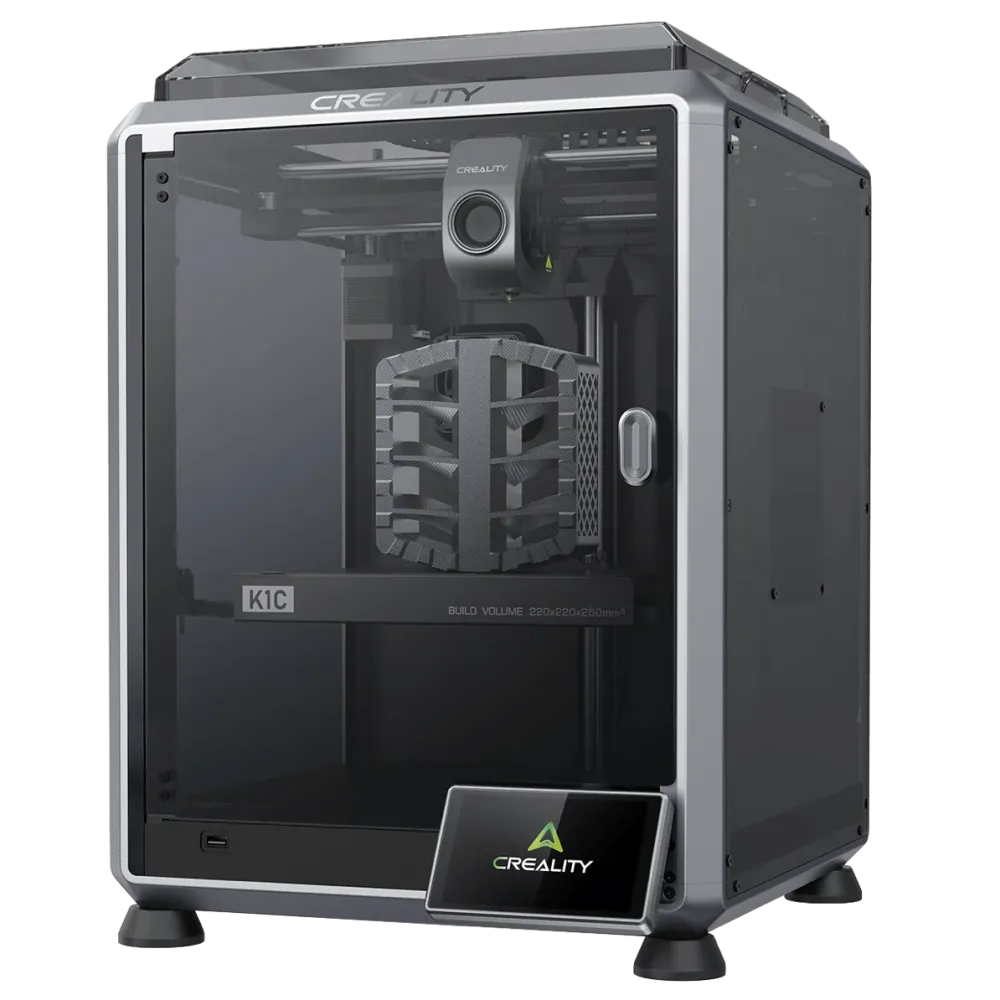
Creality K1C
BUYNo major lifecycle, firmware, availability, or support warnings detected.
Data refreshed: 16 May 2026
Where to buy
Specifications
- Build volume
- 220x220x250 mm
- Build size class
- Medium - Daypack / Backpack
- Price
- €349 (solo)
- Enclosure
- Full enclosure
- Chamber control
- None
- Materials
- ABS · ASA · HIPS · Nylon (PA6/PA12) · PETG · PHA · PLA (all variants) · PVB · TPU · TPC · TPE
- Support materials
- —
- Bowden nozzle
- —
- Max hotend temp
- 300°C
- Max bed temp
- 100°C
- Max chamber temp
- —
- Nozzle material
- Hardened Steel
- Hardened nozzle
- Included — CF/GF abrasive variants. While Nylon-CF not possible at this tier.
- Nozzle count
- 1
- Max filament inputs
- 1
- True multi-material
- —
- Tool change
- Single Nozzle Pause Swap
Ownership
- Experience level
- Beginner-friendly
- Assembly
- Minimal
- Auto bed leveling
- Automatic
- Auto Z offset
- Yes
- Auto first layer
- Yes
- Runout sensor
- Yes
- Spaghetti detection
- Yes
- Error guidance
- Error Coded
- Warranty
- 3-12 months
- Spare parts
- Partial
- Firmware version
- 1.1.0.27
Who this is for
The K1C suits first-time buyers who want engineering-adjacent material capability — ABS, ASA, and Nylon — without the complexity those materials typically demand. The enclosed design and broad automation make that accessible from the start. Multi-color printing is fully manual here, which makes it a poor fit for buyers expecting hands-off color management. Those who prioritize long-term firmware progression would be better served by a model earlier in its product cycle.
PrintSignals Review
Creality K1C Review
Assessment
Firmware has been updated within the last six months — a positive sign for a printer at a late lifecycle stage, where continued maintenance is not always the norm. At this point in its lifecycle, models in Creality's lineup statistically tend to see reduced activity, though no official replacement has been announced. This is a risk pattern rather than a confirmed outcome. Creality's support quality is mixed across its product line, which compounds that uncertainty for buyers depending on sustained firmware development.
Build and print volume
The 220x220x250mm build area is medium-size, suited for most hobby and functional pieces without a large footprint. The full enclosure provides meaningful thermal containment, which is what allows ABS, ASA, and Nylon to be printed reliably rather than merely attempted. The chamber is not actively regulated. Passive warmth builds from the bed and motors, and for demanding materials, room temperature will influence consistency more than the 300°C hotend or 100°C bed ceiling.
Material capability
Multi-color printing on the K1C uses single-nozzle manual pause-and-swap, and no automated multi-spool expansion exists for this configuration. A single nozzle handles all material transitions, meaning cross-contamination is a real factor that limits reliable mixed-material use. The reliable material range spans PLA in all variants, PETG, ABS, ASA, HIPS, Nylon, PHA, and PVB, with the hardened steel nozzle adding support for CF and GF reinforced filaments but not Nylon-CF. The direct drive extruder provides hardware capability for flexible filaments like TPU, TPC, and TPE, though these are technically demanding and require user tuning for consistent results.
Setup and ownership
The K1C is designed for first-time owners, arriving near-fully assembled with setup typically completed in under 15 minutes. Automated bed leveling, Z-offset calibration, first-layer calibration, runout detection, and print failure detection reduce manual interventions during everyday printing, with firmware abstracting most configuration decisions. Error codes are numbered, displayed on screen, and searchable on the brand wiki. Manual lookup is required as no QR code is included, though documentation covers most situations a new user will encounter.
Support and longevity
Common wear items are partially available through official Creality channels, with third-party suppliers and community resources covering the broader parts range. The warranty spans 3 to 12 months depending on the component, meaning coverage is not uniform across the printer. Creality is generally reliable across most support dimensions, though official transparency is limited when hardware problems surface — community-sourced fixes tend to fill that gap rather than direct resolutions. The ecosystem is semi-open: open slicers and third-party filament work freely, and community modifications are available, though some smart integrations may require Creality's own software.