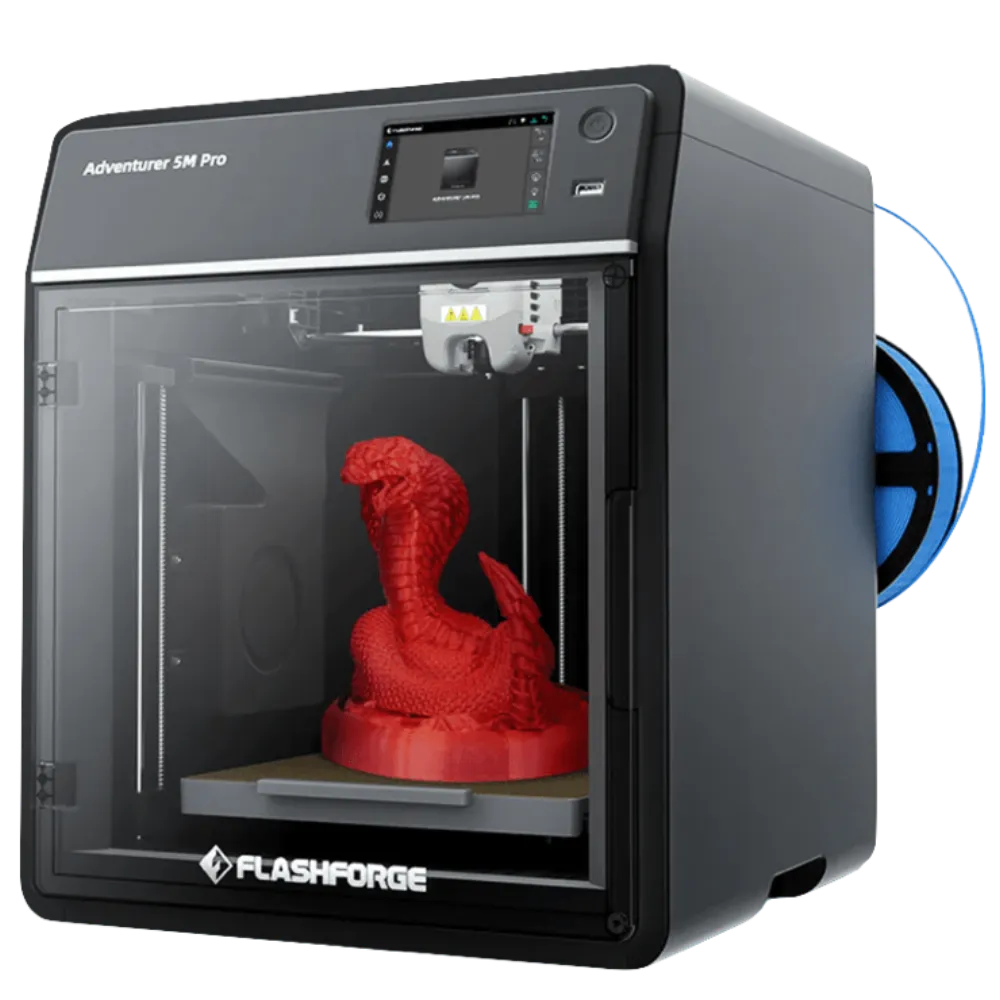
Flashforge Adventurer 5M Pro
CAUTIONFirmware updates appear to be slowing down, with no recent update signal in over 6 months.
Data refreshed: 16 May 2026
Where to buy
Specifications
- Build volume
- 220x220x220 mm
- Build size class
- Small - Shoebox
- Price
- €449 (solo)
- Enclosure
- Full enclosure
- Chamber control
- None
- Materials
- ABS · ASA · HIPS · Nylon (PA6/PA12) · PETG · PHA · PLA (all variants) · PVB · TPU · TPC · TPE
- Support materials
- —
- Bowden nozzle
- —
- Max hotend temp
- 280°C
- Max bed temp
- 100°C
- Max chamber temp
- —
- Nozzle material
- Brass
- Hardened nozzle
- —
- Nozzle count
- 1
- Max filament inputs
- 1
- True multi-material
- —
- Tool change
- Single Nozzle Pause Swap
Ownership
- Experience level
- Beginner-friendly
- Assembly
- Minimal
- Auto bed leveling
- Automatic
- Auto Z offset
- Yes
- Auto first layer
- Yes
- Runout sensor
- Yes
- Spaghetti detection
- Yes
- Error guidance
- Error Coded
- Warranty
- 3-12 months
- Spare parts
- Minimal
- Firmware version
- V3.1.9-2.2.3
Unlockable capabilities
- With hardened nozzle upgrade:
- Abrasive materials. While Nylon-CF not possible at this tier.
Who this is for
This printer suits first-time buyers who want enclosed printing, a broad material range, and minimal setup friction — and who are comfortable knowing that long-term support continuity is not assured. The manual multi-color process and compact build area will limit buyers whose plans include complex color work or large prints. Buyers prioritising reliable long-term support or true multi-material printing should look at alternatives with a more active lifecycle position.
PrintSignals Review
Flashforge Adventurer 5M Pro Review
Assessment
The brand has shown a positive support posture overall, and some continued activity for this printer remains observable. Firmware updates have slowed significantly, however, and the model is now at a point in the brand's average product lifecycle where reduced activity becomes statistically likely. That lifecycle pattern is not an official replacement announcement, but it is a meaningful risk indicator for buyers planning extended use. Timing is the core consideration here — the hardware remains capable, but the window of active manufacturer engagement is narrowing.
Build and print volume
The 220×220×220 mm build area is compact — suited to smaller parts rather than large assemblies. Full enclosure provides genuine thermal containment, reducing warping risk and enabling the reliable use of materials that struggle on open-frame printers. The hotend reaches 280°C and the bed reaches 100°C, which covers the temperature requirements of most engineering filaments. The enclosed space retains passive heat, but there is no dedicated chamber heater — materials that depend on regulated chamber temperature will not receive that support.
Material capability
The enclosed design and direct drive extruder support a broad material range: PLA, PETG, ABS, ASA, HIPS, Nylon, PHA, PVB, and flexible filaments including TPU, TPC, and TPE. Flexible materials are technically demanding — the hardware provides the capability, but reliable results require tuning beyond what setup alone delivers. The stock brass nozzle limits reliable use of abrasive filaments — a hardened nozzle is a separately purchased upgrade, though carbon-fiber Nylon remains outside what this hardware tier supports. Multi-color printing uses a manual pause-and-swap method — each color change requires hands-on filament swapping, and cross-contamination limits reliable mixed-material use.
Setup and ownership
This printer is built for first-time owners, with near-full assembly that gets most buyers printing within 15 minutes. The firmware abstracts most technical complexity, and guidance is available for most situations buyers encounter. Automatic bed leveling, Z-offset calibration, first-layer calibration, filament runout detection, and print failure detection reduce the most common sources of early frustration. When errors occur, numbered codes display on screen — there is no QR code, and resolving an error requires manually searching the brand wiki.
Support and longevity
Spare parts availability through the official store is minimal — parts not listed there may be reachable by contacting manufacturer support directly. Warranty coverage runs from 3 to 12 months depending on the component. Support quality across warranty claims, parts access, and issue resolution has shown inconsistent outcomes — community-sourced fixes tend to fill the gap that official responses leave open. The ecosystem is semi-open: compatible with major slicers and third-party filament, with community modifications available, though some smart features may require the manufacturer's own software.