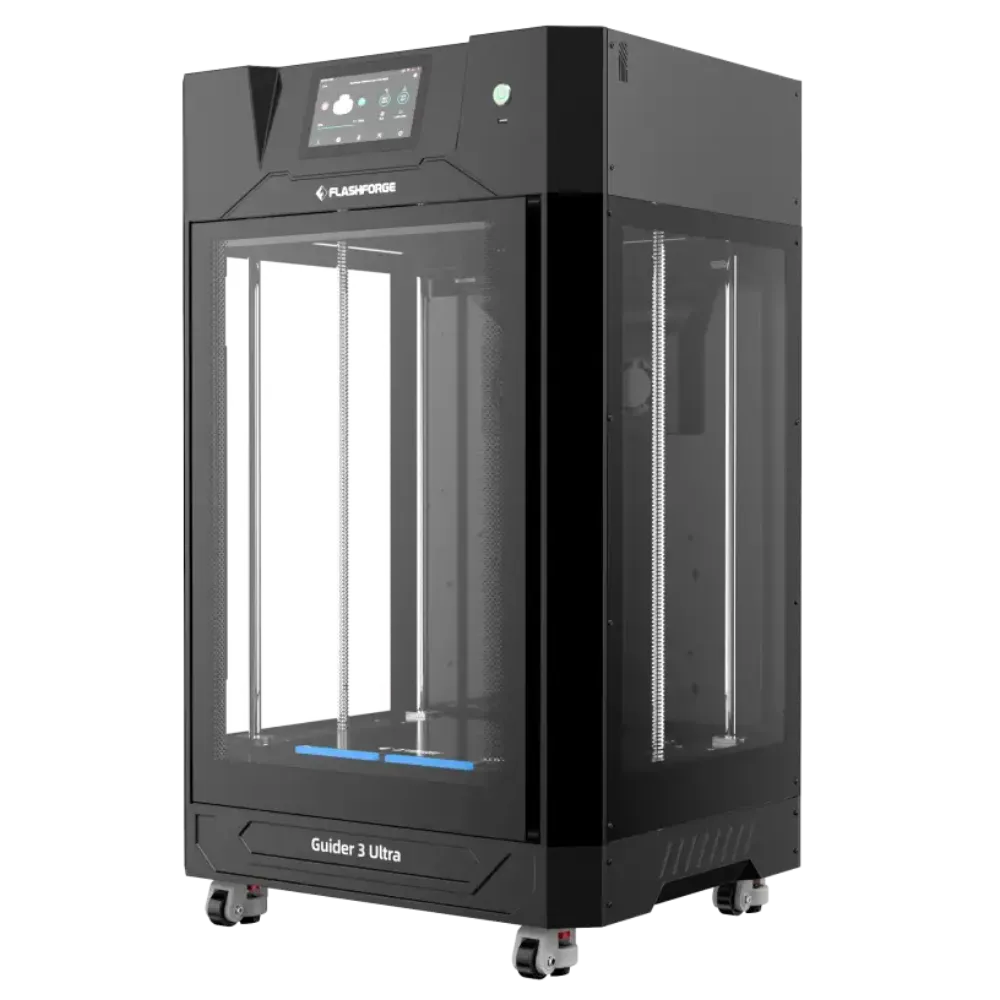
Flashforge Guider 3 Ultra
AVOIDFirmware support appears inactive, with no meaningful update signal for over a year. Support signals are limited across one or more tracked areas such as documentation, spare parts access, repair guidance, or support visibility.
Data refreshed: 16 May 2026
Where to buy
Specifications
- Build volume
- 300x330x600 mm
- Build size class
- Large - Carry-on Suitcase
- Price
- €2,999 (solo)
- Enclosure
- Full enclosure
- Chamber control
- None
- Materials
- ABS · ASA · HIPS · Nylon (PA6/PA12) · PETG · PHA · PLA (all variants) · PVB · TPU · TPC · TPE
- Support materials
- PVA · PVOH · BVOH as simultaneous support material
- Bowden nozzle
- —
- Max hotend temp
- 350°C
- Max bed temp
- 120°C
- Max chamber temp
- —
- Nozzle material
- Hardened Steel
- Hardened nozzle
- Included — CF/GF abrasive variants. While Nylon-CF not possible at this tier.
- Nozzle count
- 2
- Max filament inputs
- 2
- True multi-material
- Yes
- Tool change
- Dual Nozzle Pause Swap
Ownership
- Experience level
- Intermediate
- Assembly
- Light Build
- Auto bed leveling
- Automatic
- Auto Z offset
- Yes
- Auto first layer
- —
- Runout sensor
- Yes
- Spaghetti detection
- —
- Error guidance
- Generic
- Warranty
- 3-12 months
- Spare parts
- None
- Firmware version
- V3.1.2-2.1.7
Who this is for
The Guider 3 Ultra suits experienced users who need a large-format enclosed printer capable of dual-material extrusion and engineering-grade filaments, and who can accept the absence of ongoing firmware development. Buyers who expect active software support, accessible spare parts, or reliable official assistance at this price point will find the current conditions difficult to justify. At €2,999, the hardware capability is real — but the timing risk makes this a difficult purchase to recommend for most buyers right now.
PrintSignals Review
Flashforge Guider 3 Ultra Review
Assessment
The Guider 3 Ultra is a capable enclosed printer with hardware suited to engineering-grade materials. Firmware has received no update in over a year, however, suggesting manufacturer software support has ended — a concrete concern at this price point. The model sits at a late lifecycle stage: based on this brand's average model lifespan of roughly 2.7 years, reduced activity or replacement becomes statistically likely, though no official successor has been announced. The brand has generally shown a positive support posture, but the observed scope of that support is limited and should not be treated as assurance of continued engagement.
Build and print volume
The Guider 3 Ultra's build volume — 300 × 330 × 600 mm — accommodates tall, full-scale parts that would otherwise require splitting across multiple prints. Full enclosure provides genuine thermal containment, allowing the bed to sustain elevated temperatures without ambient drafts destabilising heat-sensitive materials. The 350°C hotend and 120°C bed are capable of reaching the temperatures engineering-grade filaments require. The chamber retains passive heat from the bed and motors, but there is no dedicated heater or temperature control — materials that rely on a precisely regulated chamber environment may encounter limitations that passive heat alone cannot address.
Material capability
Two dedicated nozzles and a two-spool system are included in the standard configuration, enabling dual-material printing and soluble support materials — PVA, PVOH, and BVOH — for geometries with complex or internal supports. The enclosed build environment and sustained temperatures reliably support ABS, ASA, HIPS, Nylon (PA6/PA12), PETG, PHA, PLA, and PVB. The hardened steel nozzle handles carbon-fibre and glass-fibre abrasive filament variants, though Nylon-CF falls outside what this configuration can achieve. The direct drive extruder provides hardware capability for flexible filaments including TPU, TPC, and TPE, though results depend on tuning rather than hardware alone.
Setup and ownership
This printer suits users with some prior 3D printing experience — the firmware is well-documented and guidance covers most situations, though the dual-nozzle workflow and large build area add complexity that benefits from existing familiarity. Assembly is minor, typically 15 to 45 minutes, and automatic bed leveling, Z-offset calibration, filament runout detection, and automatic spool handoff reduce the routine monitoring burden. When something goes wrong, error output is limited to generic text messages with no structured code system — diagnosing the problem falls to the user. Multi-color prints pause at each nozzle change and require the operator to be present, making dual-material runs unsuitable for unattended operation.
Support and longevity
The ecosystem is semi-open: standard slicers and third-party filament are fully compatible, and community modifications are available, though some smart features may require the manufacturer's own software. No spare parts are listed through official channels, leaving buyers to source components through third-party suppliers or community resources. Warranty coverage spans 3 to 12 months depending on the component — a wide range that makes the scope of coverage unclear for individual parts. When hardware problems arise, official support has shown limited transparency, with community-sourced fixes tending to fill the gap more reliably than formal responses.