Flashforge Adventurer 5M
CAUTIONFirmware updates appear to be slowing down, with no recent update signal in over 6 months.
Data refreshed: 16 May 2026
Where to buy
Specifications
- Build volume
- 220x220x220 mm
- Build size class
- Small - Shoebox
- Price
- €299 (solo)
- Enclosure
- Open frame
- Chamber control
- None
- Materials
- PLA (all variants) · PETG · PHA · TPU · TPE
- Support materials
- —
- Bowden nozzle
- —
- Max hotend temp
- 280°C
- Max bed temp
- 100°C
- Max chamber temp
- —
- Nozzle material
- Brass
- Hardened nozzle
- —
- Nozzle count
- 1
- Max filament inputs
- 1
- True multi-material
- —
- Tool change
- Single Nozzle Pause Swap
Ownership
- Experience level
- Beginner-friendly
- Assembly
- Minimal
- Auto bed leveling
- Automatic
- Auto Z offset
- Yes
- Auto first layer
- Yes
- Runout sensor
- Yes
- Spaghetti detection
- —
- Error guidance
- Error Coded
- Warranty
- 3-12 months
- Spare parts
- Minimal
- Firmware version
- V3.1.9-2.2.3
Unlockable capabilities
- With hardened nozzle upgrade:
- Abrasive materials
Who this is for
The Adventurer 5M suits buyers new to 3D printing who want minimal setup, reliable results with PLA, PETG, and PHA, and an accessible entry price — provided they are comfortable with the timing risk of a late lifecycle position. Buyers who prioritize long-term manufacturer support confidence, a larger build area, engineering material capability, or a hands-free multi-color approach should look at alternatives.
PrintSignals Review
Flashforge Adventurer 5M Review
Assessment
The Flashforge Adventurer 5M is an accessible entry-level printer, and the brand has generally maintained a positive support posture for its models. At this stage in its lifecycle, however, most models in Flashforge's lineup statistically reach a point of reduced activity or replacement — this is a pattern-based observation, not an official announcement. Firmware updates have slowed noticeably, with the last known update arriving six to twelve months ago and the cadence continuing to decline. Taken together, these factors represent meaningful timing risk for a purchase intended to last several years.
Build and print volume
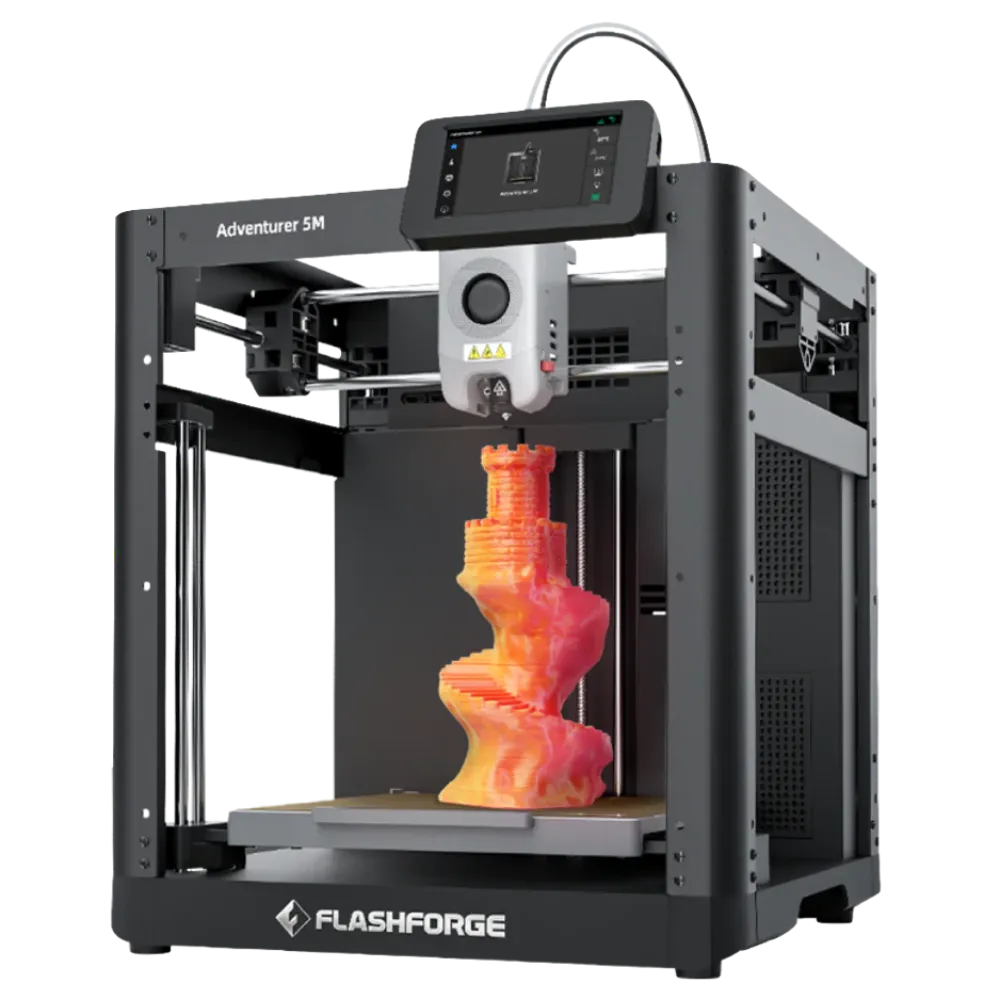
The Adventurer 5M is an open-frame printer with no enclosure to retain heat around the print area, which means ambient room conditions have a direct influence on print stability. Its build volume of 220 × 220 × 220 mm falls in the small category — practical for everyday objects but not large or complex assemblies. The hotend reaches 280°C and the bed reaches 100°C, temperatures that on paper suggest a broad material range. The open frame means those temperature ceilings are largely theoretical — the absence of thermal containment constrains real-world material compatibility far more than the hardware's limits do.
Material capability
The Adventurer 5M reliably handles PLA in all variants, PETG, and PHA. Abrasive materials require a separately purchased hardened nozzle — the stock brass nozzle is not rated for them. The direct drive extruder adds hardware capability for flexible materials such as TPU and TPE, though these are technically demanding and results depend heavily on tuning. Multi-color printing uses a manual pause-and-swap method, requiring hands-on filament swapping at each color change. The single-nozzle design introduces cross-contamination risk that limits reliable use across material combinations.
Setup and ownership
The Adventurer 5M is designed for first-time printer owners — minimal prior knowledge is needed, and the platform is well-documented with guidance available for most situations. The near-fully assembled design typically has buyers printing within fifteen minutes of unpacking. Automatic bed leveling, Z-offset calibration, first-layer calibration, and filament runout detection handle the most common day-to-day friction points. Errors appear as numbered codes on screen and are searchable on the brand wiki. There is no QR shortcut — each code requires a brief manual lookup.
Support and longevity
Spare parts availability through the official store is minimal, with very few items listed — unlisted parts may be requestable through direct contact with manufacturer support. The warranty spans 3 to 12 months depending on the component, with coverage varying by part category. Support channels exist, though resolution quality has been inconsistent across warranty claims, parts access, and technical inquiries. Community-sourced fixes tend to fill the gaps where official responses have been limited. The ecosystem is semi-open, with third-party filament and open slicers compatible and community modifications available. Some smart features may require Flashforge's own software to function.