Prusa XL
CAUTIONThis printer appears late in its lifecycle, so long-term support, parts availability, or resale value may weaken over time. If found at a strong discount and the printer still fits your needs, it may be worth comparing against newer alternatives.
Data refreshed: 16 May 2026
Where to buy
Specifications
- Build volume
- 360x360x360 mm
- Build size class
- Large - Carry-on Suitcase
- Price
- €2,384 (solo)
- Enclosure
- Optional enclosure
- Chamber control
- None
- Materials
- PLA (all variants) · PETG · PHA · TPU · TPE
- Support materials
- PVA · PVOH · BVOH as simultaneous support material
- Bowden nozzle
- —
- Max hotend temp
- 290°C
- Max bed temp
- 120°C
- Max chamber temp
- —
- Nozzle material
- Brass
- Hardened nozzle
- —
- Nozzle count
- 5
- Max filament inputs
- 5
- True multi-material
- Yes
- Tool change
- Tool Changer Pause Swap
Ownership
- Experience level
- Intermediate
- Assembly
- Extended Build
- Auto bed leveling
- Automatic
- Auto Z offset
- Yes
- Auto first layer
- Yes
- Runout sensor
- Yes
- Spaghetti detection
- —
- Error guidance
- QR Direct
- Warranty
- 12-24 months
- Spare parts
- Comprehensive
- Firmware version
- V6.4.1
Unlockable capabilities
- With hardened nozzle upgrade:
- Abrasive materials
Who this is for
The Prusa XL fits experienced users who need large-format, simultaneous multi-material printing — particularly those whose work depends on dissolvable supports for complex geometries. Its open ecosystem and direct parts access make it a strong long-term ownership option for buyers who can accept the lifecycle uncertainty at its current position. Buyers requiring engineering-material capability or lifecycle certainty will find better-timed options elsewhere.
PrintSignals Review
Prusa XL Review
Assessment
Prusa's reputation for platform-like long-term support is the strongest case for buying the XL at this stage, and active firmware updates are consistent with that track record. The concern buyers need to weigh is lifecycle position: statistically, most printers in Prusa's lineup have entered a stage of reduced support by this point — though this is a pattern, not an official statement about the XL. Prusa's history of treating products as long-lived platforms separates it from brands that quietly sunset hardware, but that posture does not guarantee an unchanged pace of active development. Buyers choosing the XL today are making a reasonable bet on continued maintenance-level support, with less certainty around new capability additions.
Build and print volume
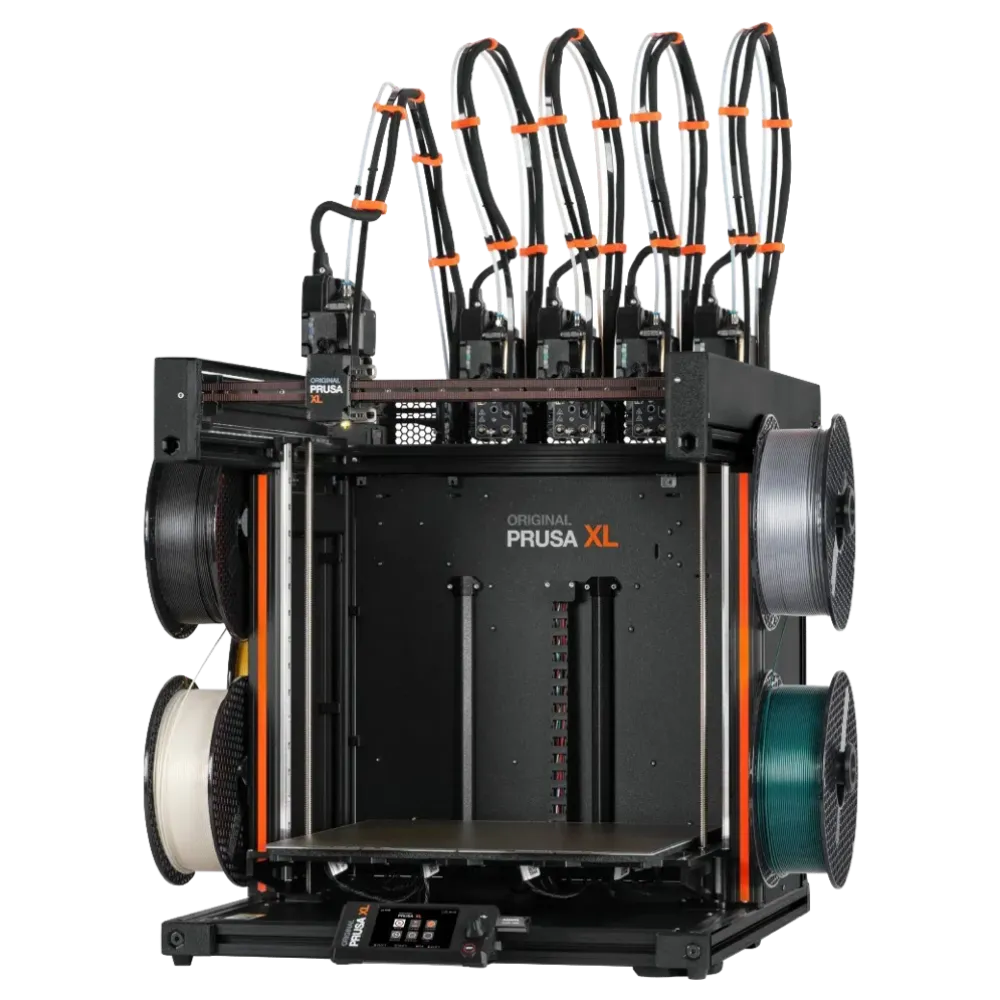
The 360×360×360 mm build area is large, suited to oversized PLA and PETG parts that would need splitting on smaller machines. In standard configuration the printer is open-frame, and thermal containment is absent — the reliable material range reflects that design limitation, not the hotend specification. An optional enclosure is available as a separate purchase and expands thermal capability, though even with it the chamber retains heat passively from the bed and motors rather than through a dedicated heater. The 290°C hotend and 120°C bed provide useful headroom for PETG-class materials, but those specs become more relevant once the enclosure is in place.
Material capability
In standard open-frame configuration, the XL reliably prints PLA, PETG, and PHA. The direct drive extruder adds hardware capability for TPU and TPE, though flexible materials require careful tuning regardless of hardware. The stock brass nozzle limits reliable use with abrasive filaments. A separately purchased hardened nozzle opens that category. Color changes use a pause-based toolchanger — each swap pauses the print and requires operator intervention, though individual swaps are fast. The five dedicated toolheads eliminate cross-contamination, making dissolvable supports such as PVA, PVOH, and BVOH a practical option. The multi-spool system, which enables automatic filament handoff when a spool runs out, is included in the bundled configuration but requires a separate purchase on the printer-only option.
Setup and ownership
The XL suits buyers with some prior 3D printing experience — managing a five-toolhead system adds workflow complexity that benefits from existing familiarity. It ships in sections requiring 45 to 120 minutes to assemble, and some mechanical comfort helps during the build. Bed leveling, Z-offset calibration, and first-layer calibration are all automated. Filament runout detection is built in, and print failure detection is available through a separately purchased add-on. On-screen QR codes link directly to targeted guidance for each error, and the documentation covers most situations a user will encounter.
Support and longevity
Prusa offers comprehensive official spare parts access directly through the manufacturer, which matters for a machine of this complexity — long-term owners are not dependent on third-party sourcing. Warranty coverage runs 12 to 24 months depending on the component, a range that reflects the modular, multi-toolhead design. Support channels are well-resourced in documentation and reach. Resolution outcomes for hardware problems have been inconsistent, however, and buyers should not assume escalation will always be straightforward. The fully open ecosystem — open-source firmware, standard G-code, and compatible with any slicer — means the printer remains community-modifiable well beyond the horizon of active manufacturer development.