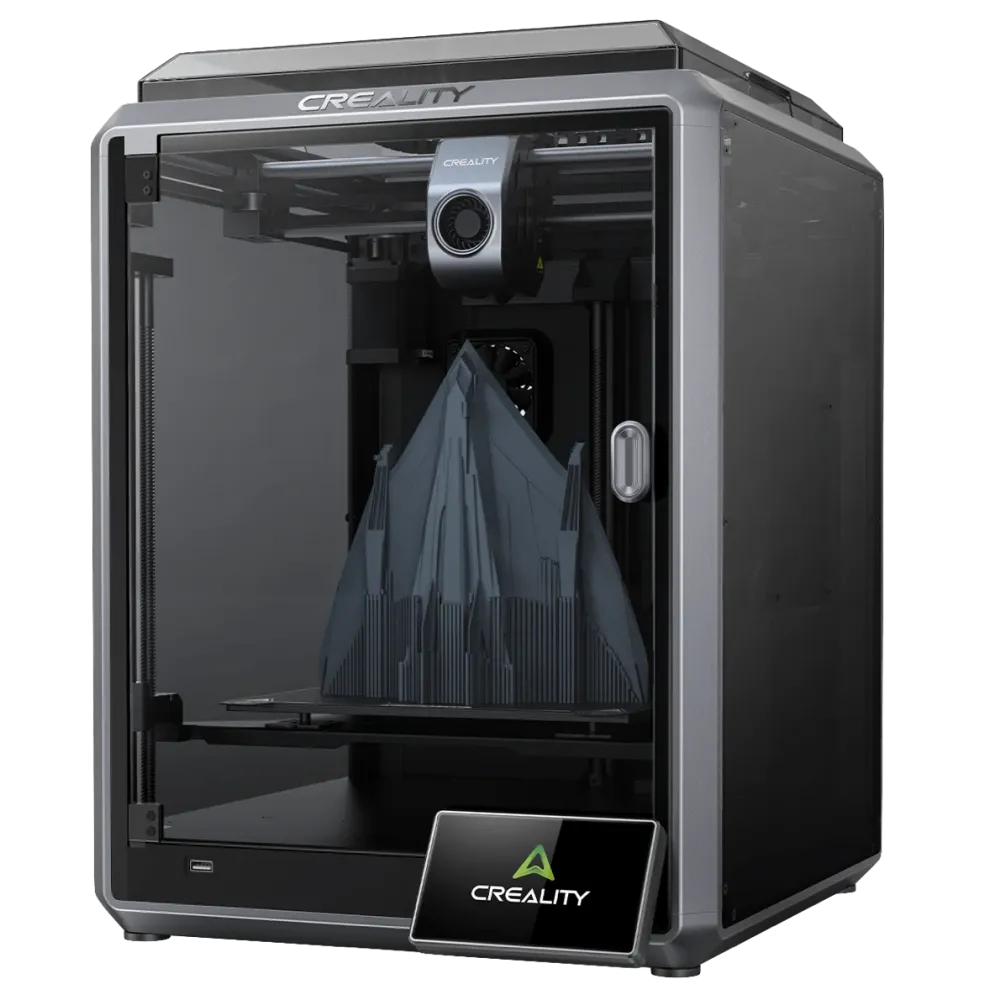
Creality K1
CAUTIONThis printer appears late in its lifecycle, so long-term support, parts availability, or resale value may weaken over time. If found at a strong discount and the printer still fits your needs, it may be worth comparing against newer alternatives.
Data refreshed: 16 May 2026
Where to buy
Specifications
- Build volume
- 220x220x250 mm
- Build size class
- Medium - Daypack / Backpack
- Price
- €329 (solo)
- Enclosure
- Full enclosure
- Chamber control
- None
- Materials
- ABS · ASA · HIPS · Nylon (PA6/PA12) · PETG · PHA · PLA (all variants) · PVB · TPU · TPC · TPE
- Support materials
- —
- Bowden nozzle
- —
- Max hotend temp
- 300°C
- Max bed temp
- 100°C
- Max chamber temp
- —
- Nozzle material
- Brass
- Hardened nozzle
- —
- Nozzle count
- 1
- Max filament inputs
- 1
- True multi-material
- —
- Tool change
- Single Nozzle Pause Swap
Ownership
- Experience level
- Beginner-friendly
- Assembly
- Minimal
- Auto bed leveling
- Automatic
- Auto Z offset
- Yes
- Auto first layer
- Yes
- Runout sensor
- Yes
- Spaghetti detection
- —
- Error guidance
- Error Coded
- Warranty
- 3-12 months
- Spare parts
- Partial
- Firmware version
- 1.1.0.27
Unlockable capabilities
- With hardened nozzle upgrade:
- Abrasive materials. While Nylon-CF not possible at this tier.
Who this is for
For someone new to 3D printing: the K1 is accessible from minute one — fully assembled, automatic calibration, well-documented guidance — though it has reached the lifecycle stage where Creality typically reduces ongoing support investment. For a home hobbyist: the enclosed build and material range including ABS, ASA, and Nylon deliver real capability for functional parts at a budget price, though multi-color printing is hands-on work at each color change rather than an automated feature. For someone upgrading from an existing printer: the enclosed design and broader material range — adding ABS, ASA, and Nylon to what an open-frame printer handles — represent a real step forward in capability, though the lifecycle position means choosing a platform moving toward reduced manufacturer attention rather than growing investment.
PrintSignals Review
Creality K1 Review
Assessment
The K1 has received a firmware update within the last six months, a sign the model has not been fully abandoned. Creality's support record is mixed across its product lines, which means continued attention to the K1 is not uniform or guaranteed. Based on the brand's typical model lifespan, the K1 is statistically past the point where most models in this lineup remain fully supported — no official discontinuation has been announced, but this reflects a historical pattern, not a confirmed fact. Future software development is likely to slow, and manufacturer attention typically shifts toward newer products at this lifecycle stage.
Build and print volume
The K1's build area — 220x220x250mm, roughly the footprint of a daypack or backpack — covers most everyday desktop objects and practical household parts. Full enclosure provides thermal containment, meaningfully reducing warping risk on temperature-sensitive materials like ABS and ASA that would be unreliable on an open-frame printer. A 300°C hotend and 100°C bed temperature support the material range the enclosure enables. The enclosed space retains passive warmth from the bed and motors, but there is no dedicated chamber heater or active temperature control.
Material capability
The K1's enclosure and 300°C hotend support a material range beyond open-frame standards — reliable options include PLA, PETG, HIPS, PVB, and PHA for general use, alongside ABS, ASA, and Nylon for parts requiring heat resistance or mechanical strength. Abrasive filaments require a hardened nozzle upgrade, and carbon-fiber-reinforced Nylon falls outside this hardware tier. The direct drive extruder makes flexible filaments like TPU, TPC, and TPE viable, though tuning is a factor and results are not automatic. Multi-color printing requires the user to manually unload and reload filament at each color change, and cross-contamination limits reliable mixed-material combinations.
Setup and ownership
The K1 arrives near-fully assembled — most buyers reach their first print in under 15 minutes. Automatic bed leveling, Z-offset calibration, first-layer calibration, and filament runout detection handle the adjustments that cause the most difficulty for new users — once calibrated, day-to-day printing proceeds without regular manual steps. Print failure detection is available as a separately purchased add-on, and the firmware is designed to guide rather than demand prior knowledge. At €329, the semi-open ecosystem means any standard slicer and third-party filaments are compatible, though some smart features may require Creality's own software.
Support and longevity
Creality's manufacturer support is generally reliable across most dimensions, though official transparency when hardware problems arise is limited — community-sourced fixes tend to fill the gap that official responses leave. The warranty covers 3 to 12 months depending on the component, leaving owners largely self-reliant once it expires. Official spare parts availability is partial — some common wear items can be sourced from Creality directly, with community sources and third-party suppliers covering the rest. Numbered error codes on screen are searchable on the Creality wiki, providing a documented troubleshooting path — though manual lookup is required each time, as no QR shortcut is present.