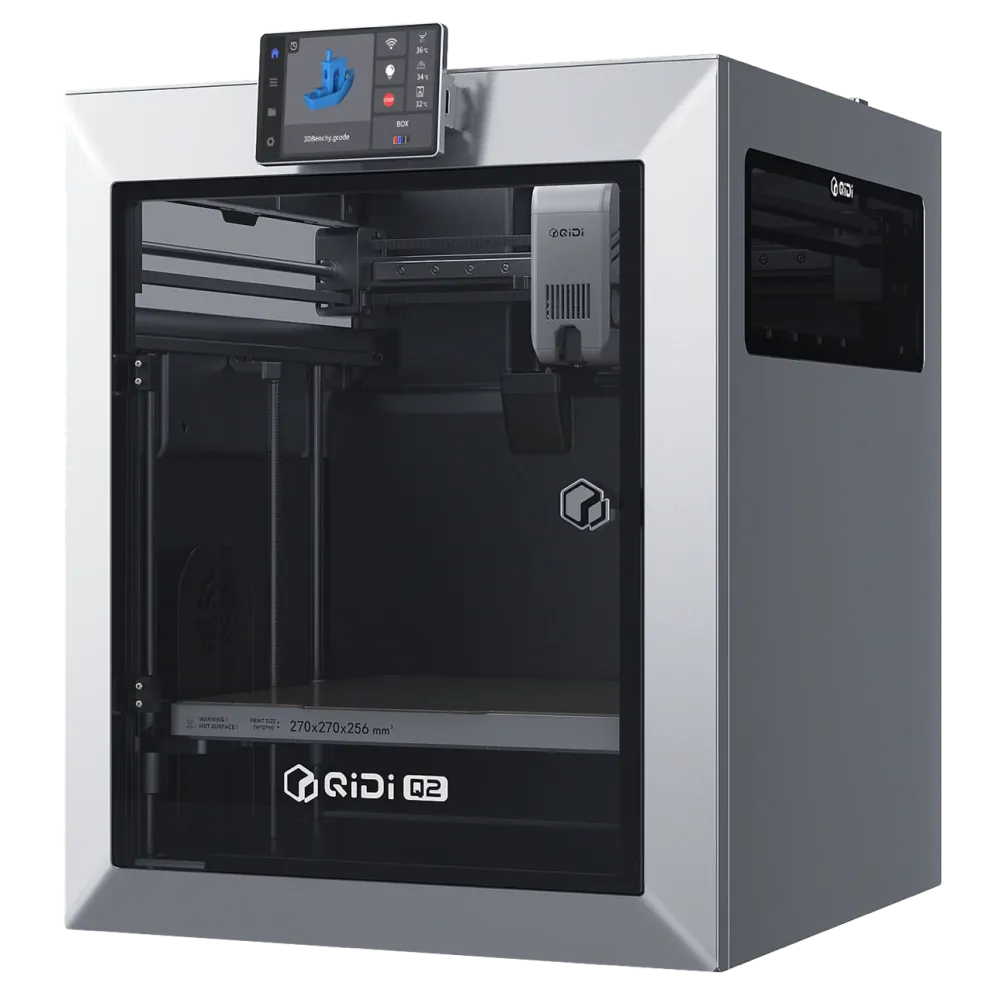
QIDI Q2
BUYNo major lifecycle, firmware, availability, or support warnings detected.
Data refreshed: 16 May 2026
Where to buy
Specifications
- Build volume
- 270x270x256 mm
- Build size class
- Medium - Daypack / Backpack
- Price
- €499 (solo)
- Enclosure
- Full enclosure
- Chamber control
- Active Controlled
- Materials
- ABS · ASA · HIPS · Nylon (PA6/PA12) · PC · PC-ABS · PETG · PHA · PLA · PPS · PVB · TPU · TPC · TPE
- Support materials
- —
- Bowden nozzle
- —
- Max hotend temp
- 370°C
- Max bed temp
- 120°C
- Max chamber temp
- 65°C
- Nozzle material
- Brass-Hardened Steel
- Hardened nozzle
- Included — CF/GF abrasive variants · Nylon-CF · PAHT-CF · PC-CF
- Nozzle count
- 1
- Max filament inputs
- 16
- True multi-material
- —
- Tool change
- Single Nozzle Purge Based
Ownership
- Experience level
- Intermediate
- Assembly
- Minimal
- Auto bed leveling
- Automatic
- Auto Z offset
- Yes
- Auto first layer
- Yes
- Runout sensor
- Yes
- Spaghetti detection
- Yes
- Error guidance
- Generic
- Warranty
- 3-12 months
- Spare parts
- Partial
- Firmware version
- V1.1.1
Who this is for
The Q2 is a strong fit for intermediate users who want reliable access to engineering-grade materials — ABS, ASA, Nylon, PC, and high-temperature polymers — and are comfortable with Klipper-based tuning as a standard part of ownership. Multi-color capability requires the separately purchased add-on, adding to the total outlay for buyers who want that feature. Those who prioritize responsive manufacturer support or expect structured error guidance when problems arise will find this printer a poor match.
PrintSignals Review
QIDI Q2 Review
Assessment
The Q2 is a mid-cycle product with no visible replacement on the horizon, and recent firmware updates confirm it is actively maintained rather than winding down. These factors make the timing relatively low-risk for buyers entering now. The brand's support posture introduces some caution — coverage across warranty, parts, and issue resolution is inconsistent, with community-sourced fixes frequently filling gaps that official channels leave open. Buyers who depend on responsive manufacturer support should factor that limitation in before committing.
Build and print volume
The 270×270×256mm build area places the Q2 in the medium-size class — practical for a wide range of part sizes without reaching large-format territory. Full enclosure with active chamber heating is the more consequential design feature: maintaining up to 65°C inside the print environment is what prevents warping in engineering-grade materials, regardless of hotend capability alone. The 370°C hotend and 120°C bed are matched to that chamber environment, covering the thermal requirements of high-performance polymers.
Material capability
Multi-color printing requires the separately purchased multi-spool add-on, which scales from 4 to 16 inputs and enables automatic spool handoff on runout. Color swaps are purge-based and slow, generating waste with each change. This is not a true multi-material system — a single nozzle handles all inputs, and cross-contamination limits reliable mixed-material combinations. The material range covers PLA, PETG, ABS, ASA, HIPS, Nylon (PA6/PA12), PC, PC-ABS, PPS, PVB, and PHA, with the hardened-steel nozzle handling abrasive CF and GF variants. The direct drive extruder supports flexible filaments such as TPU, TPC, and TPE, though reliable results require tuning.
Setup and ownership
The Q2 suits buyers with some 3D printing experience. Klipper-based firmware means tuning, calibration, and debugging are expected parts of ownership rather than exceptional events. Assembly is near-complete from the factory, and most buyers reach first print in under 15 minutes. Bed leveling, Z-offset calibration, first-layer calibration, runout detection, and failure detection are all automated, reducing the recurring burden of operation. Error messages are generic with no structured code system, leaving diagnosis to the buyer.
Support and longevity
Some common wear items can be sourced from the manufacturer, though the official parts selection is partial rather than comprehensive. Warranty coverage runs from 3 to 12 months depending on the component, with core parts potentially carrying shorter protection than the machine overall. When hardware issues arise, warranty claims, parts access, and resolution outcomes are handled inconsistently. Community resources tend to fill the gap that official support leaves. The ecosystem is fully open — Klipper-based firmware, standard G-code, and compatibility with any slicer give buyers full control over their toolchain without manufacturer lock-in.