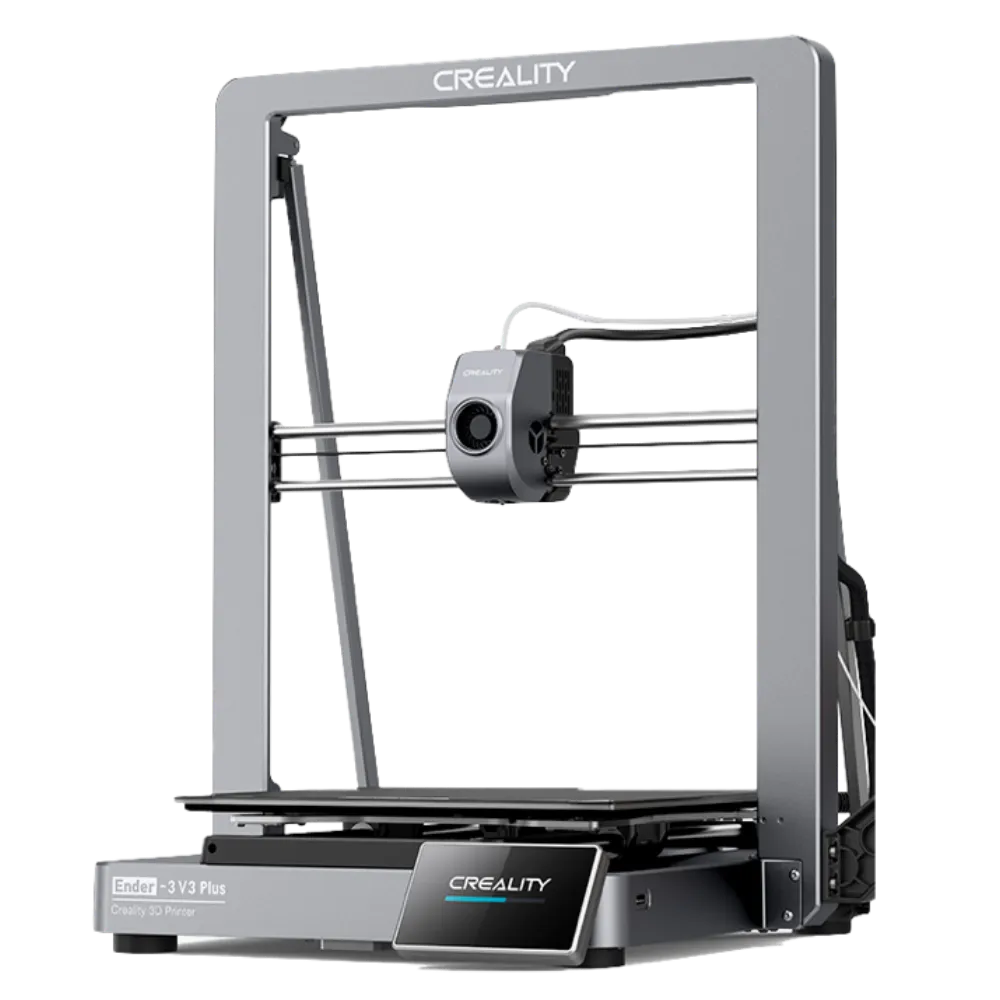
Creality Ender-3 V3 Plus
AVOIDFirmware support appears inactive, with no meaningful update signal for over a year.
Data refreshed: 16 May 2026
Where to buy
Specifications
- Build volume
- 220x220x250 mm
- Build size class
- Medium - Daypack / Backpack
- Price
- €399 (solo)
- Enclosure
- Open frame
- Chamber control
- None
- Materials
- PLA (all variants) · PETG · PHA · TPU · TPE
- Support materials
- —
- Bowden nozzle
- —
- Max hotend temp
- 300°C
- Max bed temp
- 110°C
- Max chamber temp
- —
- Nozzle material
- Brass
- Hardened nozzle
- —
- Nozzle count
- 1
- Max filament inputs
- 1
- True multi-material
- —
- Tool change
- Single Nozzle Pause Swap
Ownership
- Experience level
- Tinkerer
- Assembly
- Light Build
- Auto bed leveling
- Automatic
- Auto Z offset
- Yes
- Auto first layer
- —
- Runout sensor
- —
- Spaghetti detection
- —
- Error guidance
- Generic
- Warranty
- 3-12 months
- Spare parts
- Minimal
- Firmware version
- 1.2.3.28
Unlockable capabilities
- With hardened nozzle upgrade:
- Abrasive materials
Who this is for
The Ender-3 V3 Plus fits experienced tinkerers who want an open, configurable system for printing PLA, PETG, and PHA, and who are comfortable working without active manufacturer firmware development. Buyers who depend on ongoing firmware improvements, reliable spare parts access, or structured support when problems arise will find this printer's current position difficult to accept. For those who can work within those constraints, the hardware may still serve its purpose — but the lifecycle position is the dominant factor in this decision.
PrintSignals Review
Creality Ender-3 V3 Plus Review
Assessment
No official replacement for the Ender-3 V3 Plus has been announced, and mechanically the printer may still perform well. The concern is timing: based on this brand's average model lifespan of approximately 2.5 years, this printer statistically falls into the range where reduced activity or replacement becomes more likely — this is a pattern, not a confirmed roadmap. Firmware updates have ceased entirely, with no release in over a year, pointing to ended software support rather than a temporary pause. Brand support varies across this manufacturer's product lines, and these factors together mean a buyer is most likely committing to a printer at the end of its active development.
Build and print volume
The 220 x 220 x 250 mm build volume places this printer in a mid-size category, suitable for a wide range of everyday prints within that footprint. The open-frame design means there is no thermal containment, which matters more for material choice than the 300°C hotend or 110°C bed temperature ceilings might suggest. Without enclosure control, ambient air disrupts heat retention across longer prints, limiting the reliable material range to warp-stable filaments regardless of what the hardware can technically reach.
Material capability
The reliable material range covers PLA in all variants, PETG, and PHA — extending to abrasive filaments requires a separately purchased hardened nozzle, as the stock nozzle is brass. The direct-drive extruder adds mechanical capability for flexible filaments such as TPU and TPE, though these are technically demanding and consistent results depend on tuning, not hardware alone. Multi-color printing is available through manual pause-and-swap, requiring the user to manually unload and reload filament at each color change point. This is not a true multi-material system — one nozzle handles all swaps, and cross-contamination limits reliable mixed-material use across any combination.
Setup and ownership
This printer suits experienced users prepared for tuning, calibration, and debugging as expected parts of ownership. The firmware is Klipper-based or minimally abstracted, meaning the machine rewards deep engagement rather than surface-level operation. Assembly takes roughly 15 to 45 minutes, and automatic bed leveling and Z-offset calibration ease the recurring setup burden. Error feedback is limited to generic text or raw firmware output, leaving diagnosis to community resources and independent research.
Support and longevity
Spare parts availability through the official store is minimal — few items are listed, though additional parts may be obtainable by contacting manufacturer support directly. Warranty coverage spans 3 to 12 months depending on the component, introducing variability in how long different parts remain protected. When hardware problems arise, resolution is inconsistent: official transparency is limited, and community-sourced fixes tend to fill the gap that formal support leaves. The ecosystem is fully open, with standard G-code and compatibility with any slicer, meaning this printer can be modified and maintained independently of whatever happens to official support.