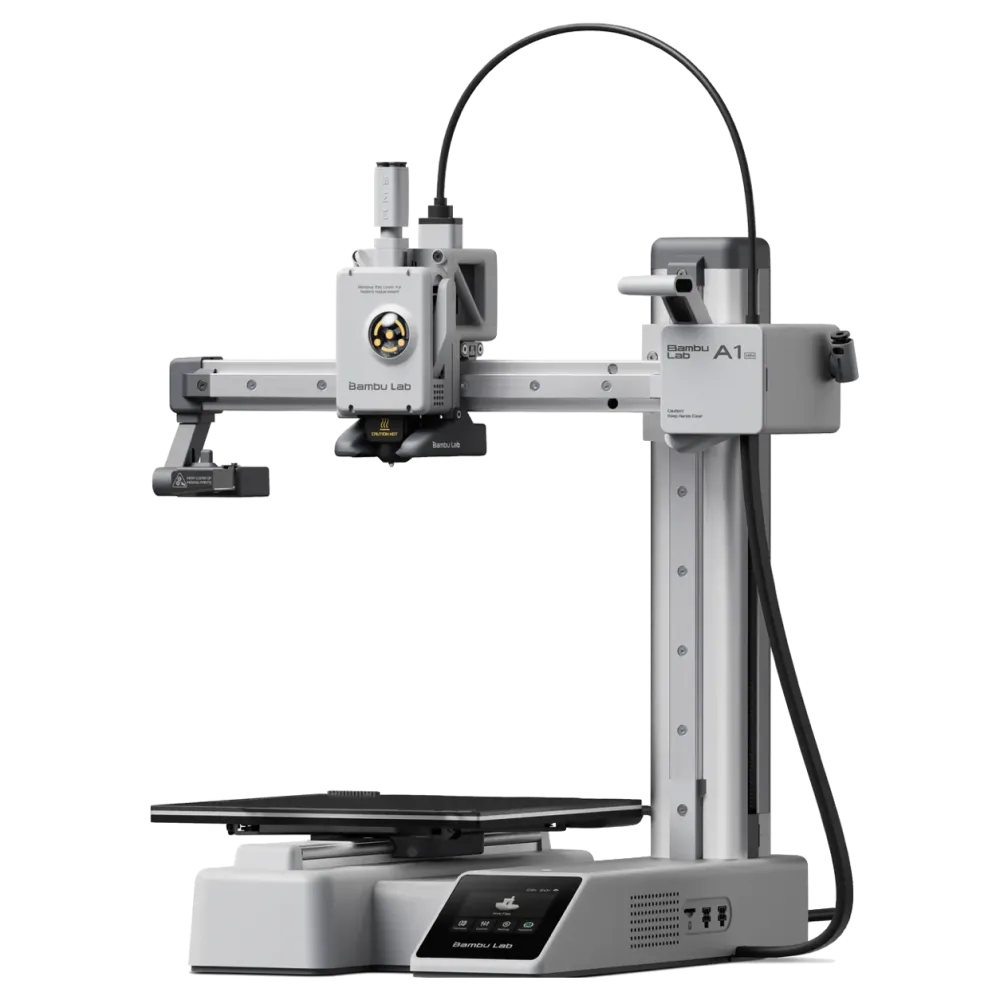
Bambu Lab A1 mini
CAUTIONThis printer appears late in its lifecycle, so long-term support, parts availability, or resale value may weaken over time. If found at a strong discount and the printer still fits your needs, it may be worth comparing against newer alternatives.
Data refreshed: 16 May 2026
Where to buy
Specifications
- Build volume
- 180x180x180 mm
- Build size class
- Extra-small - Hand-held Parts
- Price
- €189 (solo)
- Enclosure
- Open frame
- Chamber control
- None
- Materials
- PLA (all variants) · PETG · PHA · TPU · TPE
- Support materials
- —
- Bowden nozzle
- —
- Max hotend temp
- 300°C
- Max bed temp
- 80°C
- Max chamber temp
- —
- Nozzle material
- Stainless Steel
- Hardened nozzle
- —
- Nozzle count
- 1
- Max filament inputs
- 16
- True multi-material
- —
- Tool change
- Single Nozzle Purge Based
Ownership
- Experience level
- Beginner-friendly
- Assembly
- Light Build
- Auto bed leveling
- Automatic
- Auto Z offset
- Yes
- Auto first layer
- Yes
- Runout sensor
- Yes
- Spaghetti detection
- —
- Error guidance
- QR Direct
- Warranty
- 3-12 months
- Spare parts
- Comprehensive
- Firmware version
- 01.08.00.00
Unlockable capabilities
- With hardened nozzle upgrade:
- Abrasive materials
Who this is for
For someone new to 3D printing: the automated setup, guided error codes, and published software support through September 2028 make this a low-friction entry point, though the lifecycle position means long-term manufacturer investment beyond that window is uncertain. For a home hobbyist: the budget price and optional multi-color capability offer genuine flexibility, but the extra-small 180×180×180mm build area and closed ecosystem are real constraints if you regularly print larger objects or depend on third-party tools. For someone upgrading from an existing printer: the A1 mini's automation layer means calibration and common failure points are handled without manual intervention, but the build area and restriction to warp-stable filaments mean the capability and scale ceiling does not meaningfully expand.
PrintSignals Review
Bambu Lab A1 mini Review
Assessment
Firmware has been updated within the last 90 days, and Bambu Lab has published formal software support through September 2028 — both pointing toward continued manufacturer investment. The A1 mini is nonetheless past the statistical lifecycle threshold where most models in this brand's lineup have historically moved toward reduced support, though this reflects a pattern in the data, not an official discontinuation announcement. That distinction matters: there is no announced end date, and the published support deadline provides a defined minimum. Buyers should weigh the possibility that hardware-level investment may taper as the model ages, particularly beyond the software support window.
Build and print volume
The A1 mini's 180×180×180mm build area means output is limited to hand-held-scale parts — suitable for detailed models, compact mechanical components, and small accessories, but not for structural pieces or large household objects. The design is open-frame, meaning there is no thermal enclosure around the print area. Ambient conditions directly influence print stability, which limits reliable material use to filaments that hold their shape without active heat retention. The 300°C hotend ceiling is capable, but without an enclosure and with a bed limited to 80°C, the controlling constraint is the environment, not the hotend temperature.
Material capability
Multi-color printing requires the multi-spool system, a separately purchased add-on that expands the printer to 4 filament inputs — extendable to 16 — and enables automatic filament handoff when a spool runs out. The base printer reliably handles PLA in all its variants, PETG, and PHA — capable, widely-used materials covering most home and workshop applications. The direct drive extruder makes flexible filaments like TPU and TPE hardware-compatible, though consistent results require tuning. Abrasive filaments require a hardened nozzle upgrade. Color swaps use a single nozzle with purge-based flushing, generating waste and extending print time with each change. The system is not suited to reliably mixing different material types.
Setup and ownership
The A1 mini requires 15 to 45 minutes of minor mechanical setup and is designed to work from first use without prior 3D printing knowledge. Automatic bed leveling, Z-offset calibration, first-layer calibration, and filament runout detection handle the most common sources of print failure without manual input. On-screen QR codes link directly to targeted fixes when errors occur, removing the need to search through external documentation. The printer sits in the budget price tier at €189. The multi-spool system is a separately purchased add-on. The closed ecosystem is optimized for Bambu Lab's own slicer and consumables, and third-party tool access requires manufacturer authorization.
Support and longevity
Bambu Lab has published a software support commitment through 20 September 2028, giving buyers a defined minimum window regardless of lifecycle positioning. Spare parts are comprehensively available through official channels, covering a wide selection of components. Warranty coverage ranges from 3 to 12 months depending on the component. When hardware problems have arisen, this manufacturer has publicly taken ownership and followed through with official fixes — the strongest support responsiveness pattern observed across available evidence.