Anycubic Kobra S1
CAUTIONThis printer appears late in its lifecycle, so long-term support, parts availability, or resale value may weaken over time. If found at a strong discount and the printer still fits your needs, it may be worth comparing against newer alternatives.
Data refreshed: 16 May 2026
Where to buy
Specifications
- Build volume
- 250x250x250 mm
- Build size class
- Medium - Daypack / Backpack
- Price
- €349 (solo)
- Enclosure
- Full enclosure
- Chamber control
- Passive Controlled
- Materials
- ABS · ASA · HIPS · Nylon (PA6/PA12) · PETG · PHA · PLA (all variants) · PVB · TPU · TPC · TPE
- Support materials
- —
- Bowden nozzle
- —
- Max hotend temp
- 320°C
- Max bed temp
- 120°C
- Max chamber temp
- —
- Nozzle material
- Brass
- Hardened nozzle
- —
- Nozzle count
- 1
- Max filament inputs
- 8
- True multi-material
- —
- Tool change
- Single Nozzle Purge Based
Ownership
- Experience level
- Beginner-friendly
- Assembly
- Minimal
- Auto bed leveling
- Automatic
- Auto Z offset
- Yes
- Auto first layer
- Yes
- Runout sensor
- Yes
- Spaghetti detection
- Yes
- Error guidance
- QR Partial
- Warranty
- 3-12 months
- Spare parts
- Minimal
- Firmware version
- 2.7.2.1
Unlockable capabilities
- With hardened nozzle upgrade:
- Abrasive materials. While Nylon-CF not possible at this tier.
Who this is for
The Kobra S1 suits first-time owners who want an enclosed printer capable of engineering-range materials without a steep setup curve. The optional multi-spool add-on makes it a viable entry point for multi-color work, though buyers who need dependable long-term manufacturer support should weigh the lifecycle uncertainty carefully. Those who prioritize parts availability, consistent warranty outcomes, or a multi-year ownership horizon should treat the lifecycle position as a genuine risk factor.
PrintSignals Review
Anycubic Kobra S1 Review
Assessment
The Kobra S1 remains actively supported, with firmware updated within the last 90 days and a brand that has generally maintained its models past replacement. The lifecycle position adds an important caveat: based on this brand's historical average of around 12 months per model, the S1 statistically sits at the point where full manufacturer support tends to narrow. No official discontinuation has been announced, and this reflects a statistical pattern rather than a confirmed outcome. Buyers who prioritize long-term manufacturer backing should treat this lifecycle position as a real timing consideration before committing.
Build and print volume
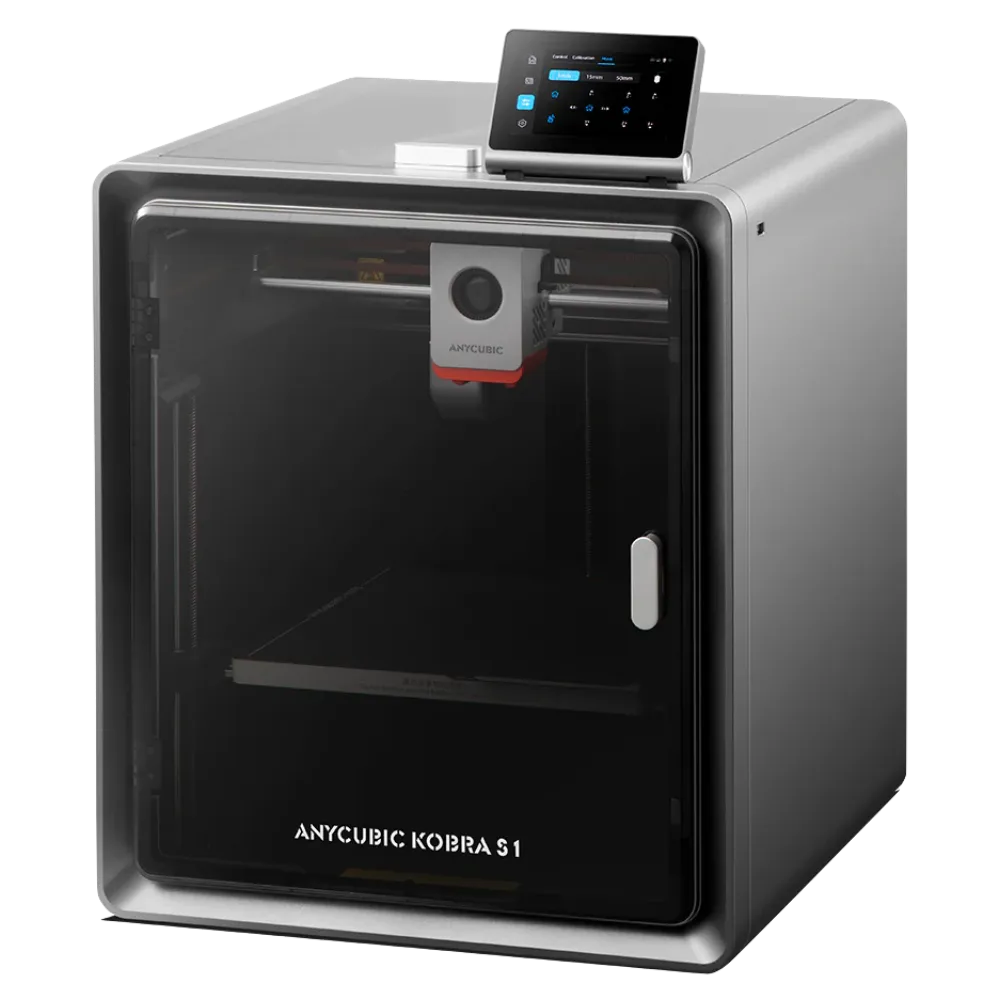
The 250×250×250 mm build area is a medium-size footprint, suited for single-piece mid-size parts and multi-component builds within those dimensions. Full enclosure provides genuine thermal containment, reducing warping risk and making engineering-range materials accessible in a way open-frame printers cannot. The chamber is passively managed, not actively heated: retained heat from the bed and motors raises the internal temperature, but actual conditions depend on ambient room temperature and timing. A manufacturer-stated hotend rated to 320°C and bed to 120°C provide adequate thermal headroom for the full material range this printer is designed to handle.
Material capability
Multi-color printing requires the multi-spool add-on, a separately purchased upgrade that expands filament capacity from one to four inputs, expandable to eight, and enables automatic spool handoff for longer prints. Color swaps are purge-based and slow, generating waste with each change and increasing print time and cost as color count rises. A single nozzle handles all inputs, which means cross-contamination risk limits reliable mixed-material combinations. The enclosure and direct drive extruder support ABS, ASA, HIPS, Nylon (PA6/PA12), PETG, PHA, PLA, PVB, and flexible filaments including TPU, TPC, and TPE, though abrasive materials require a hardened nozzle upgrade and Nylon-CF is beyond this nozzle tier.
Setup and ownership
The Kobra S1 is designed for first-time owners and assembles in under 15 minutes, with screws to remove, a few parts to clip, and a calibration sequence before printing begins. Automatic bed leveling, Z-offset, and first-layer calibration handle the most error-prone startup steps, with runout and failure detection active during prints. On-screen QR codes link to error topics, though users need to identify their specific printer model before reaching the relevant fix. Flexible filaments like TPU are hardware-supported but technically demanding, and achieving reliable results requires active tuning.
Support and longevity
Core support channels exist, and the manufacturer has generally acknowledged hardware issues publicly when they arise. Resolution outcomes have been inconsistent across warranty handling, parts access, and response quality. Spare parts are limited to a small selection in the official store, though additional items may be obtainable by contacting support directly. Warranty coverage runs 3 to 12 months depending on the component, and the printer is semi-open: compatible with open slicers and third-party filament, with community modifications available and some smart features potentially requiring the manufacturer's own ecosystem.